 LINGCORE SCI
Joint Frailty Models for Recurrent and Terminal Events
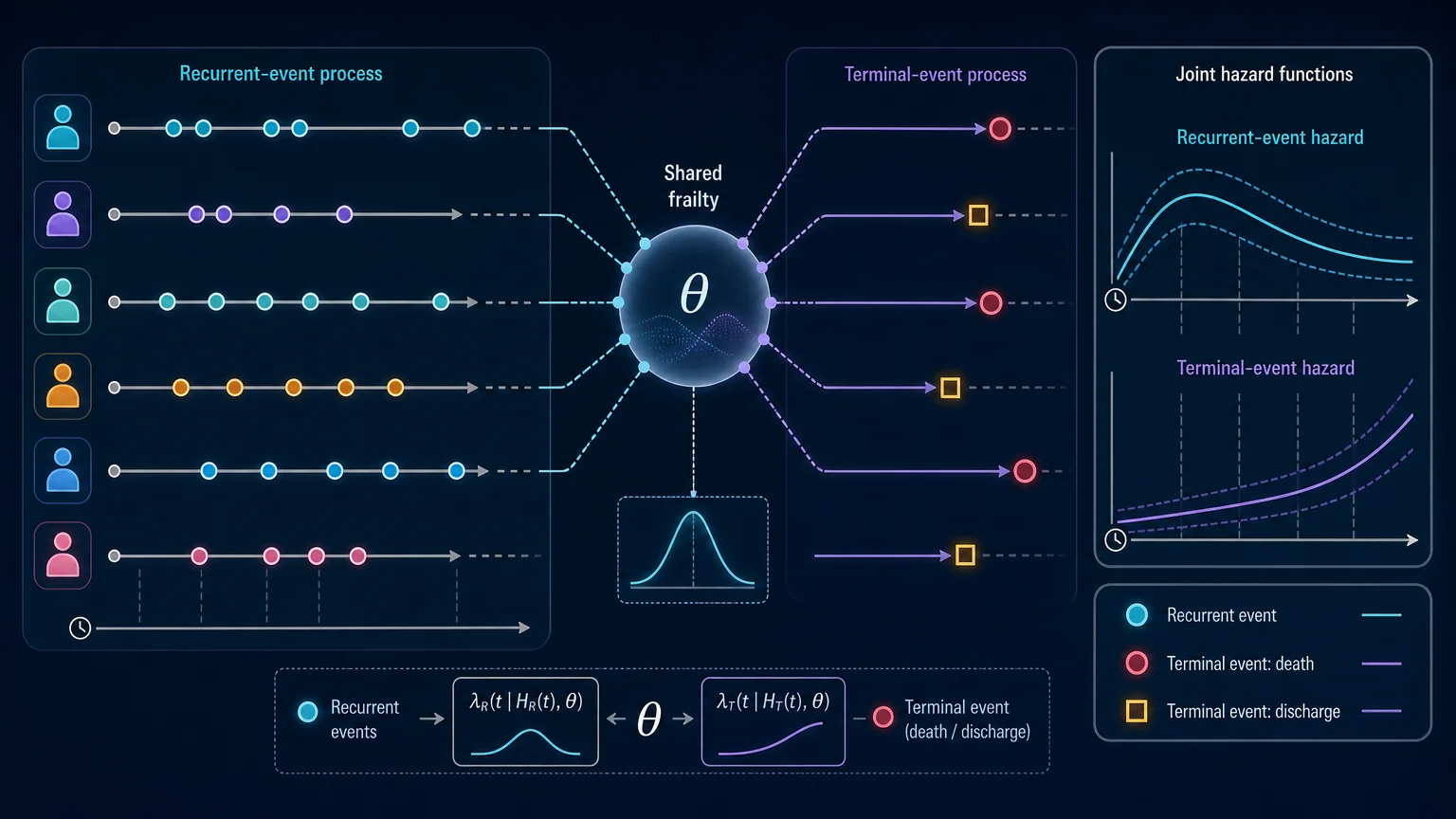
Joint frailty models analyze recurrent events and a dependent terminal event, such as death, within one likelihood-based framework. A shared latent frailty links the two processes, allowing researchers to estimate treatment or covariate effects on recurrence and terminal-event hazards without treating informative termination as ordinary non-informative censoring.
Many clinical outcomes do not occur only once. Patients may experience repeated hospitalizations, disease relapses, infections, exacerbations, bleeding episodes, or treatment interruptions. Follow-up can then end because of death, transplantation, discharge, loss to follow-up, or another terminal event. When the terminal event is related to the patient’s underlying recurrence risk, analyzing recurrent events alone can misrepresent the event process.
A common shortcut is to analyze time to the first recurrence or death. That endpoint may be clinically useful, but it discards later recurrences and can make death look equivalent to a non-fatal recurrence. Another shortcut is to censor recurrent-event follow-up at death and assume that the censoring is non-informative. That assumption is questionable when patients with a high underlying recurrence burden are also more likely to die earlier.
A joint frailty model addresses this dependence by specifying separate hazard processes for recurrent and terminal events and connecting them through an unobserved subject-level frailty. The model does not create information that the study did not collect. Its value is that it makes the dependence structure explicit, estimates it under stated assumptions, and preserves the distinction between repeated non-fatal events and the terminal outcome.
What the model is designed to represent
Let a patient contribute recurrent event times and a terminal-event time. The recurrent process may be represented with a counting-process or gap-time formulation, while the terminal process is modeled with a survival hazard. A shared frailty term introduces patient-level heterogeneity that affects both hazards. A patient with a higher latent frailty may have more frequent recurrences and a higher terminal-event hazard, although the sign and strength of this association must be estimated rather than assumed.
The two processes need separate baseline hazards and covariate effects. A treatment may reduce recurrent events without changing mortality, affect both outcomes in different directions, or alter the terminal hazard while leaving recurrence unchanged. Reporting a single composite hazard ratio would conceal those possibilities. The recurrent-event effect, terminal-event effect, and dependence parameter answer different scientific questions.
| Model component | Clinical question | Typical interpretation |
|---|---|---|
| Recurrent-event hazard | Does treatment or exposure change the rate of repeated non-fatal events? | Relative change in recurrence intensity under the chosen time scale and event-history definition. |
| Terminal-event hazard | Does treatment or exposure change death or another terminal outcome? | Relative change in the terminal-event hazard, conditional on the model and covariates. |
| Shared frailty association | How are the latent risks of recurrence and terminal events related? | Dependence between processes after accounting for measured covariates. |
| Subject-specific frailty | Which patients have higher latent event susceptibility? | A model-based latent quantity, not a directly observed clinical score. |
Why censoring at death can be informative
For a recurrent-event analysis, death removes a patient’s opportunity to experience later events. If the probability of death is related to the unobserved recurrence propensity, the observed recurrent-event histories are selectively truncated. Treating death as independent censoring can then distort recurrence-rate estimates and standard errors. The issue is not simply that fewer observations remain; the remaining observation window is related to the event process.
The same logic applies to other terminal outcomes. A patient can be discharged from an intensive-care unit, receive a transplant, or enter a competing disease state. Whether that event should be treated as a terminal event, a competing event, or a censoring event depends on the estimand and the clinical question. A joint model is not automatically correct for every setting. The terminal event must have a scientifically meaningful relationship to the recurrent process and sufficient information for estimation.
Joint frailty modeling also differs from simply adding recurrent events to a composite endpoint. A composite endpoint may be appropriate when the estimand explicitly concerns time to any component. A joint model is useful when the investigator wants to retain component-specific processes and study their dependence. The two strategies should not be presented as interchangeable.
Choosing the recurrent-event time scale
The event-history definition changes the estimand. In a total-time model, the clock begins at baseline and continues through recurrent events. In a gap-time model, the clock may reset after each event, focusing on time until the next recurrence. Some analyses count events while others model transitions between states. The choice should reflect how clinical risk evolves after an event and whether the treatment effect is expected to change with event order.
Investigators should define whether recurrent events must be clinically distinct, whether events occurring within a short window are collapsed, how same-day events are handled, and whether an event resets follow-up. A model can be mathematically sophisticated while still answering the wrong clinical question if these operational definitions are left implicit.
Model assumptions and diagnostics
A joint frailty model commonly uses proportional-hazards structures, baseline hazard functions, and a specified frailty distribution. The frailty distribution is not a decorative technical choice. Misspecification can influence the estimated dependence between recurrent and terminal processes and, in turn, the component-specific effects. Sensitivity analyses should examine whether conclusions change under plausible alternative frailty or baseline-hazard specifications.
Diagnostics should include event counts by treatment group, numbers of patients with zero, one, and multiple recurrences, follow-up duration, terminal-event frequencies, and the timing of terminal events. Plot observed recurrence patterns and terminal-event-free survival by clinically important groups. Assess whether the model reproduces the broad empirical event-history features rather than relying only on a convergence message.
When the data include clustering by hospital, family, physician, or treatment center, the recurrent-terminal dependence may coexist with higher-level clustering. A subject-level shared frailty alone may not absorb site-level dependence. The analysis plan should distinguish patient heterogeneity from cluster correlation and explain how standard errors and baseline hazards address both.
Joint frailty models versus neighboring strategies
| Strategy | What it preserves | Important boundary |
|---|---|---|
| Time to first event | A simple, familiar endpoint. | Discards later recurrences and may combine clinically different events. |
| Andersen–Gill or counting-process model | Repeated events with risk-set updating. | Requires an appropriate dependence and terminal-event strategy; it does not by itself solve informative termination. |
| Negative binomial rate model | Event counts over a defined follow-up period. | Can be inadequate when follow-up is truncated by a dependent terminal event or when event timing is central. |
| Competing-risks model | Mutually exclusive terminal causes or event types. | Does not automatically model repeated non-terminal events and terminal outcomes jointly. |
| Joint frailty model | Recurrent and terminal processes plus latent dependence. | More assumption-sensitive and computationally demanding; component-specific estimands must be explicit. |
| Win Ratio | Hierarchical comparisons of composite outcomes. | Answers a pairwise hierarchical comparison question rather than estimating shared latent event dependence. |
Researchers comparing these approaches should also read the site’s guides to restricted mean survival time, competing risks, joint longitudinal and survival models, and win ratio. Those methods can be complementary, but they do not answer the same estimand.
Five steps for a defensible analysis
| Step | Research action | Quality gate |
|---|---|---|
| 1. Define the estimand | Specify the recurrent event, terminal event, population, treatment contrast, time origin, time scale, and effect measures. | Recurrence and terminal outcomes are not hidden inside an unexplained composite. |
| 2. Map the event history | Define event ordering, gap or total time, terminal-event handling, clustering, and zero-event patients. | Every patient’s possible observation path is represented in the data structure. |
| 3. Pre-specify the joint model | State baseline hazards, frailty distribution, covariates, dependence parameter, estimation method, and competing terminal events. | Model choices are made before examining which specification gives the preferred effect. |
| 4. Check fit and sensitivity | Compare observed and fitted event patterns and vary plausible frailty or baseline-hazard assumptions. | Convergence, sparse event patterns, influential observations, and parameter stability are documented. |
| 5. Report components separately | Present recurrent-event effects, terminal-event effects, dependence estimates, absolute event summaries, and clinical interpretation. | The discussion does not replace component results with one vague “overall” claim. |
Evidence Summary Table
| Source | Contribution | Evidence boundary |
|---|---|---|
| Henderson, Diggle, and Dobson, 2000 PubMed record | Describes a joint frailty model for recurrent disease events and survival, with shared frailty and separate treatment parameters. | Foundational methods and heart-failure application; assumptions and data structure remain study-specific. |
| Joint frailty model for recurrent events and death, 2020 PubMed record | Addresses dependence between recurrent events and death and considers cure fractions with recurrent and terminal processes. | Model extension; cure assumptions should not be added without substantive justification. |
| Joint modeling of recurrent events and a terminal event, 2020 Open-access article | Develops a joint frailty framework for recurrent events and a terminal event, including estimation and clinical data illustration. | Applied methodological evidence; implementation and interpretation depend on the chosen frailty structure. |
| A joint frailty model for recurrent and competing terminal events, 2024 Open-access article | Links recurrent events with competing terminal outcomes in an ICU clinical-trial application. | Useful for competing terminal events; the target estimand must distinguish death, discharge, and other endpoints. |
| Joint frailty modeling of time-to-event data, 2022 PubMed record | Uses multivariate random effects to connect recurrent-event and terminal-event hazards and discusses patient-specific latent risk. | Methodological extension; patient-specific frailty is model-based and not a validated clinical score. |
Reporting checklist
A transparent manuscript should state why a joint model is needed rather than a first-event analysis, count model, or ordinary recurrent-event model. Define the recurrent and terminal outcomes, the observation window, the event-history rules, and the handling of zero-event participants. Report the number of recurrent events, terminal events, and patients at each stage of follow-up.
Describe the frailty distribution, baseline hazard representation, dependence parameter, covariate effects, estimation algorithm, convergence criteria, missing-data approach, and sensitivity analyses. Give component-specific effect estimates with uncertainty intervals and explain their clinical meaning. If competing terminal events are modeled, show how each terminal outcome enters the likelihood and whether any terminal outcome is treated as independent censoring.
Finally, distinguish statistical dependence from causation. A positive frailty association may indicate shared vulnerability, residual heterogeneity, or model structure; it is not automatically evidence that recurrent events cause death. The strength of a joint frailty analysis comes from an explicit estimand, a defensible event-history representation, and transparent sensitivity analysis.
Researcher's Toolkit
Use Lingcore SCI to structure, audit, and prepare recurrent-event research:
- Paper Analyzer: extract event definitions, censoring rules, frailty assumptions, and component-specific estimates from a published study.
- Review Builder: compare recurrent-event, competing-risks, joint-frailty, and composite-endpoint evidence with source-linked boundaries.
- Journal Matcher: identify journals aligned with survival analysis, clinical trials, real-world evidence, and medical biostatistics.
Medical Disclaimer: This article is for research and educational purposes only. It does not provide medical advice, treatment recommendations, or a substitute for protocol-specific statistical review. Researchers must verify methods against the original sources, data structure, estimand, and clinical context before using them in a study or manuscript.