 LINGCORE SCI
Collider Bias in Clinical Epidemiology: DAGs and Selection
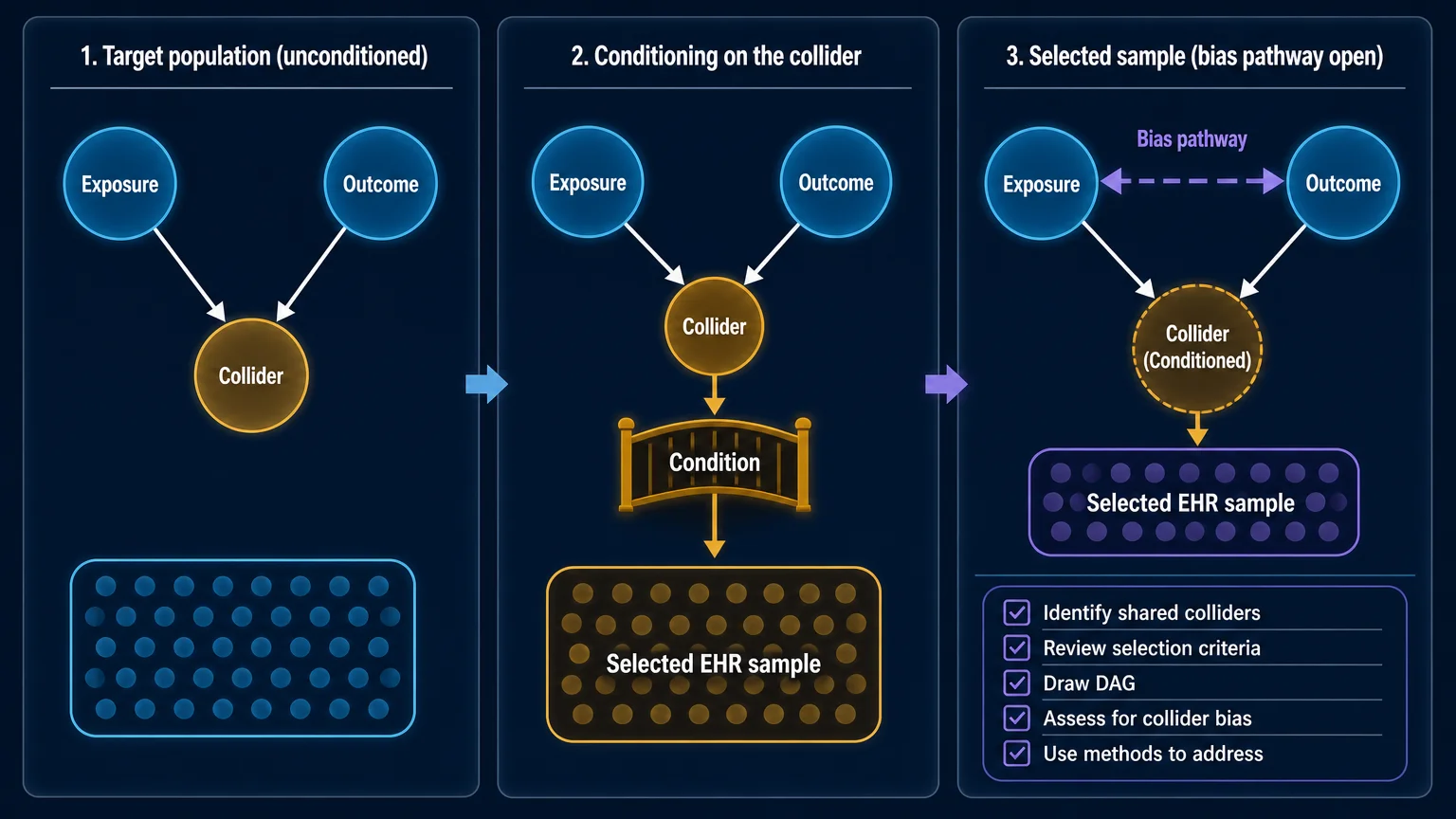
Collider bias arises when an analysis conditions on a variable influenced by both the exposure and the outcome, or by their causes. Conditioning can open a non-causal pathway, creating, reversing, or exaggerating an association. In clinical epidemiology, the collider may be explicit—such as hospital admission—or implicit, such as healthcare utilization, complete-record availability, or selection into an analytic cohort.
Researchers often learn that confounders should be controlled. That principle is important, but it is incomplete. A variable can be associated with both the exposure and the outcome without being a confounder, and adjusting for it can make an analysis worse. The central distinction is causal structure: a common cause creates an open back-door path that may need to be blocked, whereas a common effect creates a closed path that may become open after conditioning.
This distinction matters in retrospective clinical studies because inclusion criteria, referral patterns, diagnostic testing, hospital admission, and data completeness are rarely random. A dataset can therefore look large and clinically detailed while representing a selected population whose membership depends on causes of both the exposure and outcome. The resulting association may be precise but not causally interpretable.
A directed acyclic graph (DAG) makes the problem explicit. It does not prove that the assumed causal relationships are correct. Instead, it records the investigator’s causal knowledge and shows which paths are blocked or opened by selection and adjustment. The appropriate workflow is to define the target population and estimand, draw a prespecified DAG, identify the selection mechanism, and only then decide which variables belong in the analysis.
What makes a variable a collider?
Suppose an exposure A and an outcome Y both cause a third variable C. The structure is A → C ← Y. The two arrowheads meet at C, so C is a collider on that path. Without conditioning on C or its descendant, the path between A and Y is closed through the collider. If the analysis restricts the sample to a level of C, adjusts for C, or conditions on a downstream variable, the path can open.
Once opened, information about A can become statistically related to information about Y through the selection mechanism, even when there is no causal effect of A on Y. The induced association can have either direction. It may look protective, harmful, or null depending on the causal strengths, prevalence, measurement, and selection rule. Collider bias is therefore not identified by the sign of an estimate; it is identified by the mechanism that created the analytic sample or adjustment set.
A collider can also be a descendant of a collider. For example, a latent disease severity variable may influence both treatment and admission, while admission influences whether a patient enters an EHR cohort. Conditioning on admission can transmit the same selection problem even if the original common effect is not directly included in the regression model.
Selection, adjustment, and conditioning are the same causal concern
Selection bias is often discussed as a sampling problem, while collider bias is discussed as a regression problem. In practice, both can arise from conditioning on a common effect. Selecting only hospitalized patients, adjusting for hospital attendance, requiring a specialist visit, and including only patients with complete measurements may all impose a condition on the data-generating process.
| Study decision | Possible collider mechanism | Question for the protocol |
|---|---|---|
| Hospital-based cohort | Admission may be influenced by exposure-related illness and outcome-related severity. | Would the exposure and outcome cause hospital entry through different pathways? |
| Specialist clinic sample | Referral or specialist utilization may be caused by both symptoms and suspected disease. | Does clinic attendance define the target population or merely create a selected sample? |
| Complete-case analysis | Data completeness may depend on health status, access, treatment, or prognosis. | What causes a participant to have all required measurements observed? |
| Diagnostic-test subgroup | Being tested may depend on clinical suspicion, exposure history, and early symptoms. | Is test receipt part of the estimand or an unexamined selection gate? |
| Post-treatment adjustment | A follow-up variable may be affected by treatment and by later outcome risk. | Is the variable a mediator, a collider, or a time-varying confounder affected by prior treatment? |
Not every selection variable is a collider, and not every selection problem has the same mathematical form. The practical point is not to label all selection as collider bias. The point is to make the selection mechanism explicit and use the DAG to determine whether conditioning closes or opens relevant paths.
Why EHR reuse is especially vulnerable
Electronic health records are generated through clinical care, not through a probability sample of the community. The probability of having a diagnosis code, laboratory result, imaging record, medication record, or repeated visit can depend on symptoms, disease severity, clinician suspicion, insurance, transportation, local services, and prior healthcare use. These causes may also be related to the exposure and outcome under study.
The article by Weiskopf and colleagues describes healthcare utilization as a collider in EHR data reuse. A patient can enter an analytic dataset because an exposure-related condition increases care-seeking or because an outcome-related condition increases referral. Restricting the analysis to patients who have used a particular service may then create an association that would not appear in the target population.
This problem also affects generalizability. A selected EHR cohort may not represent the target population even if collider bias does not create a strong internal association. External validity and internal validity should therefore be evaluated separately. A study can be internally biased, externally non-transportable, or both.
“More complete data” is not automatically “less biased data.” Requiring a minimum number of visits or laboratory measurements may improve measurement availability but also select patients with more severe disease or more stable access to care. The inclusion rule should be treated as part of the causal design, not as a neutral data-cleaning step.
Collider bias is not confounding
Consider three common structures:
- Confounding: A ← U → Y. The common cause U creates a non-causal path between exposure and outcome. If U is measured and correctly specified, adjustment can block that path.
- Mediation: A → M → Y. The mediator lies on part of the causal effect. Adjusting for it changes the estimand from a total effect toward a direct-effect question.
- Collider structure: A → C ← Y. The common effect closes the path by default. Conditioning on C can open a non-causal pathway.
A variable’s clinical importance does not determine which structure it occupies. A measurement can be a confounder in one study, a mediator in another, and a collider in a third because the exposure, outcome, timing, and target estimand differ. Covariate selection should therefore not be justified only by statistical association, availability, or a rule that every baseline variable must enter the model.
This is also why automated variable selection is not a causal adjustment strategy. A variable selected by a prediction algorithm may improve discrimination while opening a causal path or changing the population represented by the analysis. Prediction and causal effect estimation require different variable-selection logic.
How to use a DAG before analysis
A DAG should be drafted before outcome-driven model searching. Start with the target population, exposure, outcome, time zero, and estimand. Add variables that plausibly cause the exposure, outcome, selection process, or measurement process. Mark variables that define inclusion, follow-up, testing, or data availability. Then inspect whether conditioning on any of these variables opens a path between exposure and outcome.
DAGitty can help researchers represent causal assumptions and identify adjustment sets, but software cannot supply the underlying clinical knowledge. The graph should be informed by subject-matter expertise, temporal ordering, prior evidence, and the protocol. A graph that is technically valid but clinically implausible is not rescued by a polished visualization.
| DAG review step | What to document | Common failure |
|---|---|---|
| Define the estimand | Total effect, direct effect, prognosis, prediction, or descriptive association; target population and time horizon. | Changing the adjustment set without stating that the estimand changed. |
| Map selection | Eligibility, referral, admission, testing, retention, complete-case status, and analytic inclusion. | Calling selection a technical preprocessing detail. |
| Classify variables | Confounders, mediators, colliders, effect modifiers, and post-treatment variables. | Adjusting for every variable associated with the outcome. |
| Check descendants | Whether measured variables are downstream of a collider or selection event. | Removing the visible collider while retaining its selected descendants. |
| Plan sensitivity analysis | Alternative target populations, selection definitions, and plausible selection mechanisms. | Reporting only the model with the most favorable estimate. |
Five-step workflow for a defensible clinical analysis
| Step | Research action | Quality gate |
|---|---|---|
| 1. Specify the target | State who should be represented, the exposure contrast, outcome, time zero, and estimand. | The target population is not silently replaced by “patients with available data.” |
| 2. Draw the data-generating process | Map causes of exposure, outcome, selection, testing, follow-up, and measurement in a prespecified DAG. | Selection and data availability have explicit nodes. |
| 3. Audit conditioning | List every restriction and adjustment, including hospital use, referral, complete-case status, and post-baseline variables. | Each condition has a causal justification rather than only a statistical rationale. |
| 4. Estimate and stress-test | Fit the prespecified analysis and compare results under plausible alternative selection definitions or adjustment sets. | Effect direction, magnitude, precision, and target population are compared transparently. |
| 5. Report the boundary | Separate causal interpretation, prognosis, association, internal validity, and transportability. | The manuscript does not claim that a DAG or sensitivity analysis proves no bias. |
What can and cannot fix collider bias?
The first remedy is design: avoid unnecessary conditioning on a common effect. If a hospital-based sample is not required by the research question, consider a sampling frame that better matches the target population. If testing is part of the scientific question, define the estimand conditional on testing rather than presenting the result as a population-wide effect.
When selection is unavoidable, researchers may use methods that explicitly model sampling or selection, such as inverse-probability-of-selection weighting, transportability methods, two-phase designs, or quantitative selection-bias analyses. These methods require measured variables and defensible models for selection. Weighting does not automatically repair unmeasured causes of selection or violations of positivity.
Negative control analyses can sometimes help detect residual systematic error, but they do not make a collider safe to adjust for. Likewise, propensity-score methods address a specified treatment-assignment structure; they do not guarantee protection from selection induced by conditioning on healthcare utilization or data completeness. Methods should be matched to the causal problem rather than used as generic bias-removal labels.
For a broader framework on unmeasured confounding, misclassification, and selection assumptions, see the site’s guide to quantitative bias analysis. For a general causal design perspective, see causal inference in observational medical research. The distinction between a collider problem and a measurement-error problem should remain explicit in the analysis plan.
Evidence Summary Table
| Source | Contribution | Evidence boundary |
|---|---|---|
| Weiskopf et al., 2023 PubMed record · Open-access article | Explains why healthcare utilization can act as a collider in EHR data reuse and introduces DAG-based reasoning for cohort selection. | Methodological tutorial; the actual direction and size of bias depend on the data-generating process and selection mechanism. |
| Lipsitch, Tchetgen Tchetgen, and Cohen, 2010 PubMed record | Introduces negative controls as tools for detecting confounding and bias in observational studies. | Negative controls can inform bias assessment under assumptions; they do not replace a prespecified causal design. |
| Lu, Gonsalves, and Westreich, 2024 Open-access article | Clarifies the relationship between selection bias and collider stratification bias and emphasizes the role of actual selection. | Conceptual clarification; not every selection problem is identical to collider stratification. |
| Textor et al., 2016 DAGitty methods paper | Describes a graphical approach and software implementation for identifying adjustment sets and biasing paths. | Software operationalizes stated assumptions; it cannot validate clinical knowledge or causal direction. |
| Hernán and Robins, Causal Inference: What If Open book resource | Provides a broader framework for causal questions, confounding, selection bias, inverse probability weighting, and target trial emulation. | Conceptual and methodological reference; study-specific identification still depends on design assumptions. |
How to report collider risk in a manuscript
Describe the source population and every analytic restriction in operational terms. State whether inclusion required admission, referral, a test, a minimum number of visits, complete covariates, or follow-up data. Explain why the selected population corresponds to the estimand. If the analysis is conditional on a selected population, do not silently generalize the estimate to all eligible patients.
Include a DAG or a clear causal rationale for covariate selection. Distinguish variables adjusted for confounding from variables included for prediction, precision, missing-data handling, or transportability. If a variable is post-treatment or downstream of selection, state its role and explain why it is or is not included.
Report sensitivity analyses that change the selection definition or plausible selection parameters when justified. Present how the estimate changes, not only whether a p-value crosses a threshold. A stable result across several defensible selection specifications is informative, but it is not proof that the underlying assumptions are true.
Collider bias is best treated as a design problem rather than a late-stage regression diagnosis. The strongest manuscript makes the target population, selection mechanism, DAG assumptions, adjustment strategy, and interpretation boundary visible before presenting the effect estimate.
Researcher's Toolkit
Use Lingcore SCI to audit causal structure and reporting decisions:
- Paper Analyzer: extract study populations, selection criteria, conditioning variables, DAG claims, and causal interpretation from published papers.
- Review Builder: organize evidence on collider bias, EHR selection, negative controls, weighting, and quantitative sensitivity analysis with source-linked caveats.
- Journal Matcher: identify journals aligned with clinical epidemiology, causal inference, medical informatics, and real-world evidence.
Medical Disclaimer: This article is for research and educational purposes only. It does not provide medical advice, treatment recommendations, or a substitute for protocol-specific epidemiologic or statistical review. Researchers must verify methods against the original sources, data structure, estimand, and clinical context before using them in a study or manuscript.