 LINGCORE SCI
Trial Sequential Analysis: Controlling Random-Error Risk in Cumulative Meta-Analysis
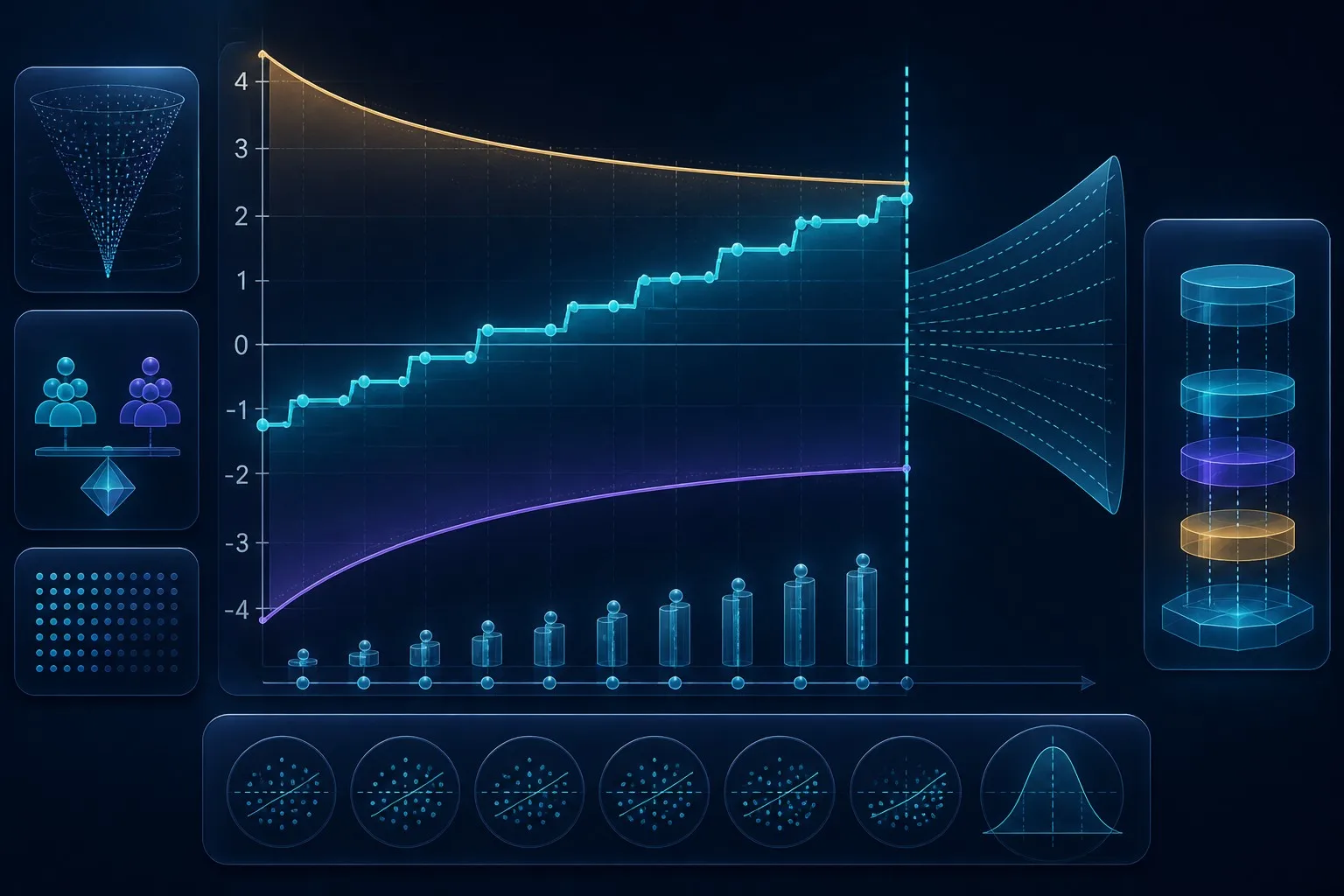
Trial Sequential Analysis (TSA) applies group-sequential monitoring boundaries to cumulative meta-analysis, adjusting the required significance level for sparse data and repeated significance testing as trials accumulate. It estimates the required information size (RIS) and provides TSA-adjusted confidence intervals, helping reviewers decide whether firm evidence has been reached, whether more trials are needed, or whether futility has been established.
A meta-analysis is updated every time a new randomized trial is published. Each update repeats a statistical test on accumulating data, and each repetition increases the risk of a spurious significant result. This is the same multiplicity problem that motivates group-sequential designs in a single trial, but it is rarely controlled in the meta-analysis setting. Trial Sequential Analysis (TSA) was developed by the Copenhagen Trial Unit and colleagues to treat each newly added trial as an interim analysis of the accumulating evidence, applying formal monitoring boundaries to the meta-analysis itself.
Conventional meta-analysis assumptions do not automatically control type I error (false-positive) or type II error (false-negative) risk when the analysis is repeated. Random error from sparse data, small-trial bias, publication bias, and repeated significance testing can produce conclusions that later evidence reverses. TSA does not eliminate bias from flawed trials, but it quantifies how much random error remains and whether the accumulated information supports firm conclusions.
1. Why repeated meta-analysis testing inflates error rates
When a conventional meta-analysis reaches p < 0.05, reviewers often treat the result as definitive. Yet if the same research question has been analyzed multiple times as trials accumulated, the probability of at least one false-positive finding across those analyses exceeds the nominal 5% level. Updating a meta-analysis after each new trial is statistically equivalent to performing interim looks at accumulating data.
Small trials add another layer of risk. Small randomized trials are more vulnerable to reporting bias, outcome-measurement bias, early stopping for benefit, and random variation. A meta-analysis dominated by small trials may reach significance because of bias and random error rather than a true effect, even when the pooled estimate looks precise.
TSA addresses the random component of this problem. It requires a prespecified required information size, uses trial sequential monitoring boundaries derived from group-sequential theory, and reports TSA-adjusted confidence intervals. Bias and systematic error still require separate risk-of-bias assessment, such as GRADE and the Cochrane risk-of-bias tools.
2. The required information size (RIS) and DARIS
The required information size is the number of participants (or events) that the meta-analysis would need to detect or refute a realistic intervention effect with chosen error probabilities. It is analogous to the sample size of an adequately powered single trial. In TSA, this quantity determines when the accumulated evidence reaches the amount of information needed for firm conclusions.
In a random-effects meta-analysis, the required information size is usually adjusted for the diversity of the trials, producing the diversity-adjusted required information size (DARIS). Diversity reflects how much the true intervention effects vary across trials. Greater diversity raises DARIS because more information is needed to separate a true treatment effect from between-trial variation.
The RIS calculation requires predefined inputs: the anticipated event rate or baseline risk, the minimal clinically relevant intervention effect, the type I error level (alpha), the type II error level (beta, giving power = 1 − beta), and the assumed diversity or heterogeneity. Changing any of these inputs can change the RIS and therefore change whether the meta-analysis has reached firm evidence. Prespecification is essential.
3. Trial sequential monitoring boundaries
TSA constructs benefit, harm, and futility boundaries. The benefit boundary is crossed when the cumulative Z-curve exceeds the adjusted significance threshold before the RIS is reached, indicating firm evidence of benefit that makes further trials unlikely to reverse the conclusion. The harm boundary plays the same role for harm. The futility boundary is crossed when the accumulated evidence makes it very unlikely that the remaining trials will reach the required information size with a conclusive result, indicating that additional trials are unlikely to change the conclusion.
These boundaries are based on group-sequential methods, such as the alpha-spending function of Lan and DeMets (1983) and O’Brien–Fleming boundaries, applied to the meta-analysis scale. The boundaries become progressively easier to cross as information accumulates, because early interim analyses have less information and require more extreme results.
The shape and position of the boundaries depend on the chosen method and the prespecified RIS. Different monitoring approaches can yield different boundary shapes, and the choice should be stated in the protocol. The standard TSA software offers several boundary options and requires the user to select them consciously.
4. TSA-adjusted confidence intervals
Conventional confidence intervals ignore the repeated testing problem and can be misleadingly narrow in a cumulative meta-analysis. TSA produces adjusted confidence intervals that account for the interim looks. An adjusted interval that includes the null while the conventional interval excludes it is a warning that the conventional result may be a random-error artifact.
TSA-adjusted intervals should be reported alongside conventional intervals when a TSA is performed. They give readers a realistic picture of the uncertainty of the accumulated evidence. If the adjusted interval excludes the minimal clinically relevant effect, the evidence can be considered more robust.
Reviewers should not treat a TSA-adjusted interval as the only measure of uncertainty. It adjusts for random error from repeated testing but does not correct for bias, heterogeneity, publication bias, or outcome-measurement problems. GRADE imprecision assessment can use the TSA results as part of the rating, but a comprehensive certainty assessment still needs risk-of-bias and indirectness evaluation.
5. Prespecified inputs and protocol registration
TSA results are sensitive to the values chosen for the effect, baseline risk, alpha, beta, and diversity. Post hoc selection of inputs can change the analysis from a hypothesis test into a fitted display. The protocol should state, before searching the literature, the minimal clinically relevant intervention effect, the anticipated control event rate, the error levels, and the assumed diversity or heterogeneity.
The minimal clinically relevant effect deserves particular attention. It should reflect what patients, clinicians, and guideline developers would consider worth detecting, not the smallest statistically detectable difference. Choosing an unrealistically large or small effect changes the RIS and can artificially make the evidence look conclusive or inconclusive.
Protocol registration, such as PROSPERO for systematic reviews, provides a public record of the prespecified TSA inputs. Any deviation from the protocol should be reported as a sensitivity analysis or as an explicit post hoc exploration, not silently presented as the primary analysis.
6. TSA in random-effects and diversity-adjusted settings
When heterogeneity is present, the random-effects model is the usual starting point, but the RIS must account for diversity. A meta-analysis with high diversity needs more information than one with low diversity to reach firm conclusions, because the additional between-trial variation increases uncertainty about the true effect.
Diversity is related to, but not identical with, the I² statistic. I² describes the proportion of total variation due to between-trial heterogeneity, while diversity in TSA is used to adjust the information size calculation. Reviewers should report the heterogeneity measures and the diversity-adjusted RIS together.
Subgroup and sensitivity analyses can help explain diversity. If heterogeneity is driven by identifiable clinical or methodological differences, the analysis may separate the evidence into more homogeneous groups. Each subgroup analysis should have its own prespecified RIS and monitoring boundaries, or it should be clearly labeled as exploratory.
7. Interpreting the TSA plot
A TSA plot displays the cumulative Z-statistic, the trial sequential boundaries, the conventional and adjusted significance thresholds, and the vertical RIS line. Reading the plot requires attention to which line the Z-curve crosses, and where the curve is relative to the RIS.
If the cumulative Z-curve crosses the benefit boundary before the RIS is reached, the evidence is considered firm for benefit under the prespecified assumptions. If the curve reaches the RIS without crossing a boundary, a conventional result can be interpreted with the adjusted significance level. If the curve enters the futility zone, the evidence suggests that additional trials are unlikely to change the conclusion, and further research may not be justified.
If the curve stays between the boundaries and has not reached the RIS, the evidence is neither conclusive for benefit nor for futility. This is the typical situation for underpowered meta-analyses and is a signal that more trials are needed. Reporting only the p-value and conventional interval in this situation can mislead readers.
8. Evidence summary table
| Methodology or guidance | Contribution | Practical implication |
|---|---|---|
| Copenhagen Trial Unit TSA Manual | Official user guide for the TSA software, covering RIS, DARIS, boundaries, and interpretation in English, Chinese, and Spanish. | Prespecify alpha, beta, effect, control event rate, and diversity; use TSA software for reproducible analysis. |
| Lan and DeMets, Biometrika 1983 | Alpha-spending function underlying trial sequential monitoring boundaries. | Choose the spending function and boundary method consciously and report it in the protocol. |
| Jakobsen et al. TSA recommendations | Provides structured recommendations for conducting and reporting TSA in systematic reviews. | Report TSA-adjusted CIs, define RIS inputs in advance, and describe heterogeneity. |
| Clephas et al., Anaesthesia 2022 | Step-by-step practical guide for performing and writing a TSA. | Follow a reproducible pipeline from protocol to plot to interpretation. |
| Riberholt et al., Syst Rev 2022 protocol | Identifies common and major mistakes in TSA use in published reviews. | Check that inputs are prespecified, diversity is handled, and conclusions match the boundaries. |
| GRADE imprecision assessment | Uses TSA results to inform downgrading for imprecision. | Combine TSA with risk-of-bias and indirectness assessment for overall certainty. |
9. Actionable Steps: Run a Trial Sequential Analysis
| Step | Research action | Required deliverable |
|---|---|---|
| Step 1 | Register the protocol and prespecify the minimal clinically relevant effect, control event rate, alpha, beta (power), and diversity assumption. | Prespecified TSA parameter table |
| Step 2 | Complete the systematic search and meta-analysis with conventional random-effects estimates, risk-of-bias assessment, and heterogeneity metrics. | Conventional meta-analysis results and forest plot |
| Step 3 | Calculate the required information size and the diversity-adjusted RIS (DARIS) with the TSA software. | RIS/DARIS estimate with stated inputs |
| Step 4 | Generate the TSA plot with benefit, harm, and futility boundaries, and obtain TSA-adjusted confidence intervals. | TSA plot and adjusted interval |
| Step 5 | Interpret the curve relative to boundaries and RIS, run sensitivity analyses for inputs, and report conclusions with GRADE imprecision. | Interpretation summary and certainty assessment |
10. Common mistakes in TSA use
One common error is performing TSA only when the conventional meta-analysis is significant, or reporting it as a decorative addition. TSA should be a prespecified part of the analysis plan with parameters chosen before inspecting results. Selective application of TSA can hide random-error risk in non-significant updates.
Another error is using unrealistic inputs for the effect size or control event rate. An overoptimistic assumed effect reduces the RIS and makes it easier to declare firm evidence. Reviewers should justify inputs from external evidence and report sensitivity analyses over plausible ranges.
Treating TSA as a substitute for bias assessment is also incorrect. TSA controls random error but cannot fix systematic error from flawed trials, selective outcome reporting, or publication bias. The risk-of-bias evaluation remains essential.
Finally, some reviews report the TSA conclusion without the plot or without the adjusted intervals, making the result impossible to audit. A complete TSA report includes the inputs, the plot, the boundaries used, the RIS/DARIS, the adjusted confidence interval, and the sensitivity analyses.
11. Relation to group-sequential trials and GRADE
TSA applies the logic of group-sequential trials, which are already used to monitor accumulating data within a single trial, to the meta-analysis scale. The same concern about repeated testing motivates both methods. A review that has previously covered group-sequential clinical trials will recognize the boundary logic; TSA extends it to the synthesis of completed trials.
GRADE rates imprecision by considering the optimal information size, the width of confidence intervals, and whether the interval crosses clinically important thresholds. TSA provides a quantitative framework for the optimal information size component, and TSA-adjusted intervals can support the imprecision rating. Reviewers should combine these tools rather than use one in isolation.
For clinical guidelines, TSA helps answer two questions: is the evidence conclusive, and is it conclusive for a clinically important effect? A statistically significant but clinically trivial pooled effect can still be flagged by TSA as insufficient if the RIS was based on a clinically meaningful threshold.
Researcher’s Toolkit: Strengthen Your Meta-Analysis Evidence Workflow
Trial sequential analysis requires careful protocol design, prespecified inputs, reproducible software runs, and transparent reporting. Lingcore SCI provides specialized tools for medical researchers:
- Paper Analyzer: Audit meta-analyses for repeated-testing control, RIS prespecification, diversity handling, and TSA reporting completeness.
- Review Builder: Synthesize cumulative meta-analysis evidence with verified citations and structured certainty assessments.
- Journal Matcher: Identify evidence-based medicine, biostatistics, and clinical-epidemiology journals suited to TSA-based reviews.
Conclusion
Trial Sequential Analysis turns cumulative meta-analysis from a series of informal repeated tests into a monitored evidence-generating process with controlled random-error risk. By prespecifying the required information size, applying trial sequential boundaries, and reporting adjusted confidence intervals, reviewers can distinguish firm evidence from premature conclusions. TSA is most useful when combined with rigorous risk-of-bias assessment, transparency about heterogeneity and diversity, and honest reporting of sensitivity analyses. Used properly, it protects both clinical guidelines and research planning from the random-error illusions that repeated updating can create.