 LINGCORE SCI
Survival Analysis in Clinical Oncology: Mastering Hazard Ratios and Landmark Analysis
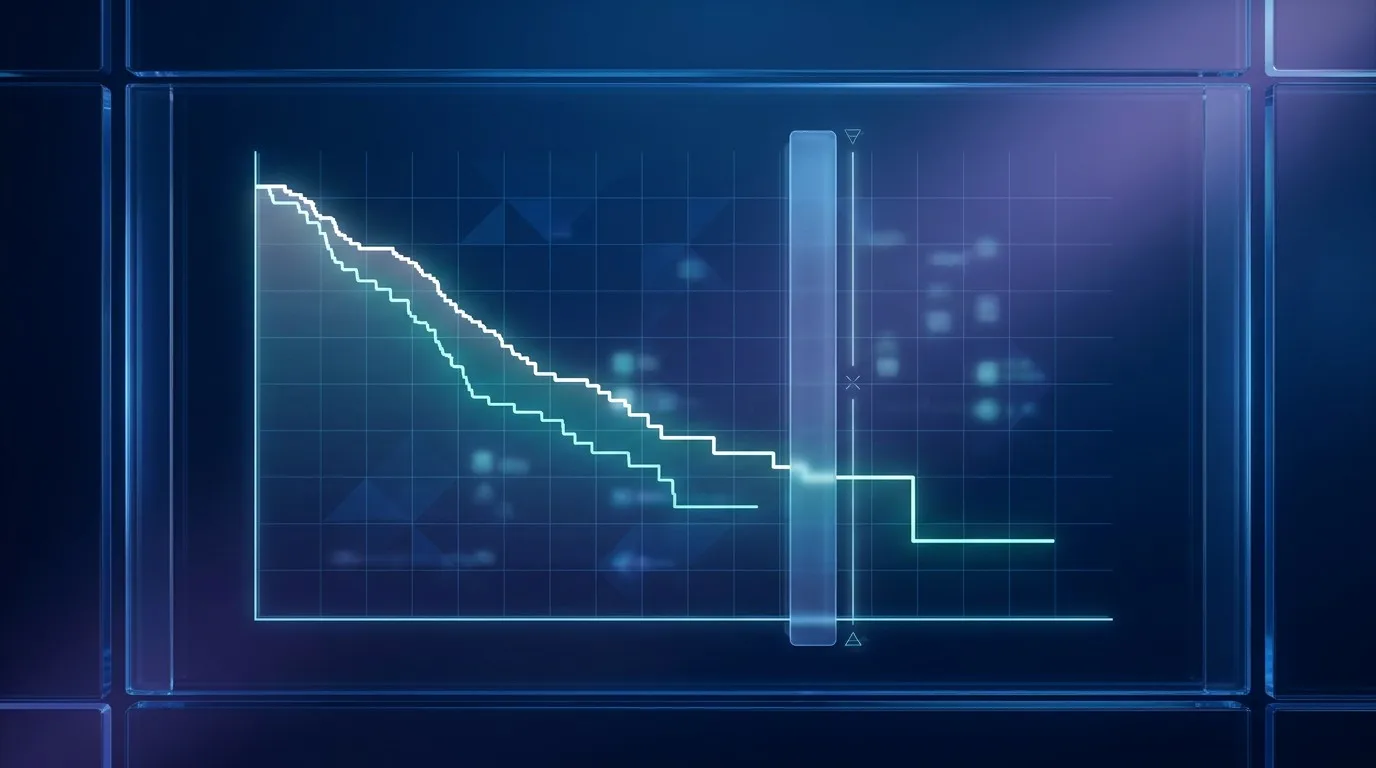
In oncology clinical trials, evaluating time-to-event outcomes—such as overall survival (OS) or progression-free survival (PFS)—is the primary mechanism for establishing therapeutic efficacy. Unlike binary outcomes, which simply record whether an event occurred, survival analysis accounts for both the occurrence of the event and the time elapsed before the event. This time-to-event structure introduces a unique statistical phenomenon known as **censoring**, where a patient's true survival time is incomplete (e.g., due to trial termination or dropout).
To analyze censored data, oncology researchers have historically relied on classic frequentist models, particularly the **Kaplan-Meier** estimator and the **Cox Proportional Hazards model**. However, contemporary clinical oncology presents complex therapeutic mechanisms—such as immunotherapies and targeted therapies—that frequently violate the foundational assumptions of these classic models. For medical researchers aiming for high-impact SCI publication, mastering advanced survival analysis techniques, such as **Landmark Analysis** and the management of **non-proportional hazards**, is now critical. This article provides a comprehensive methodological guide to navigating survival analysis in modern oncology clinical research.
1. The Cox Proportional Hazards Model: The Proportionality Pitfall
The Cox proportional hazards model is the most widely used multivariable method in oncology survival analysis. The primary output of the Cox model is the Hazard Ratio (HR), which represents the ratio of the risk of an event occurring in the treated group compared to the control group over a given time interval. A hazard ratio of $0.70$ indicates a 30% reduction in the risk of the event in the treatment group at any given point in time.
However, the validity of the Cox model depends entirely on a strict mathematical assumption: **Proportional Hazards (PH)**. This assumption states that the hazard ratio between treatment groups must remain constant over time. In 2026, with the dominance of cancer immunotherapies (e.g., immune checkpoint inhibitors), this assumption is frequently violated. Immunotherapies often demonstrate a **delayed clinical effect**, where survival curves do not separate for the first 6–12 months, followed by a dramatic survival benefit and a subsequent plateau. This results in a non-proportional, time-varying hazard ratio, making standard Cox model estimates highly biased and misleading.
2. Addressing Non-Proportional Hazards: Restricted Mean Survival Time (RMST)
When the proportional hazards assumption is violated, simply reporting a single, average hazard ratio from a Cox model can severely underestimate or overestimate a drug's true efficacy. To resolve this, modern trial protocols pre-specify alternative metrics, with Restricted Mean Survival Time (RMST) serving as the gold standard.
RMST represents the average survival time of patients followed up to a specific, restricted time horizon ($t^*$). Geometrically, RMST is the area under the Kaplan-Meier curve from time $0$ to $t^*$. By comparing the RMST of the treatment group to the control group, researchers can report a highly intuitive difference in average survival (e.g., *"Patients treated with Drug A lived an average of 4.2 months longer over a 36-month period compared to control"*). This clinical metric does not depend on the proportional hazards assumption, providing a robust, unbiased alternative for regulatory submissions and peer-review success.
3. Landmark Analysis: Combating Immortal Time Bias
In observational oncology research, investigators frequently evaluate the impact of post-baseline clinical events (such as receiving a specific secondary therapy, developing an adverse event, or achieving a molecular response) on overall survival. A common, fatal mistake is to analyze these events using standard Kaplan-Meier curves from baseline (Day 0), grouping patients based on whether they ever experienced the event.
This introduces a severe statistical error known as **Immortal Time Bias**. Patients who survive longer have a higher probability of experiencing the event, artificially inflating the survival benefit of the "event" group. Because they had to survive up to the event date to be included in that group, they are "immortal" during the time interval between baseline and the event.
To eliminate this bias, researchers must apply **Landmark Analysis**:
- Select a pre-specified **landmark time-point** (e.g., 6 months post-randomization) based on clinical plausibility.
- Exclude any patients who experienced the survival event (e.g., died) or were censored before the landmark time-point.
- Categorize the remaining patients based on whether they experienced the clinical exposure of interest *by* the landmark date.
- Analyze survival time starting strictly *from* the landmark time-point onward.
4. Competing Risks in Oncology Trial Design
Another major challenge in survival analysis is the presence of competing risks. A competing risk is an event that either prevents the primary event of interest from occurring or fundamentally alters the probability of its occurrence. For example, in a trial where the primary endpoint is cancer-specific survival, death from cardiovascular disease or other non-cancer causes acts as a competing risk.
In standard survival analysis, patients who experience a competing risk are censored. However, this violates the critical assumption of **uninformative censoring** (the assumption that censored patients have the same probability of experiencing the primary event as those remaining in follow-up). Censoring competing risks artificially inflates the cumulative incidence of the primary event over time.
To solve this, researchers must utilize **Cumulative Incidence Functions (CIF)** and the **Fine and Gray subdistribution hazards model** instead of classic Kaplan-Meier and log-rank tests. CIF calculates the exact, probability-adjusted risk of experiencing the primary cancer event in the presence of competing death events, preserving statistical validity and preventing exaggerated claims of treatment benefit.
5. Reporting Standards: The CONSORT and STROBE Requirements
When reporting survival analysis in high-impact SCI journals, adherence to established reporting guidelines is mandatory. Key statistical reporting standards include:
- Reporting the exact number of patients at risk at specified time-points underneath the Kaplan-Meier curves.
- Explicitly state and document the method used to test the Proportional Hazards assumption (e.g., Schoenfeld residuals).
- If non-proportional hazards are present, provide alternative RMST or time-dependent hazard ratio analyses.
- Clearly detail landmark time-point choices and the handling of competing risks.
Elevate Your Research with Lingcore SCI Tools
Analyzing time-to-event outcomes and navigating complex survival analysis requires absolute precision. Lingcore SCI provides specialized AI-driven tools to ensure your protocol meets the highest publication standards:
- Paper Analyzer: Audit your oncology manuscript against current CONSORT, STROBE, and biostatistical reporting guidelines.
- Review Builder: Generate structured literature reviews on survival methodologies and historical hazard models with verified citations.
- Journal Matcher: Match your oncology clinical trials or registry analyses to the high-impact SCI journals that prioritize innovative biostatistics.
Conclusion
Survival analysis is the statistical backbone of clinical oncology, but its classic models are frequently misapplied. By moving beyond standard Cox model limitations, embracing Restricted Mean Survival Time (RMST) for non-proportional hazards, and utilizing Landmark Analysis to eliminate immortal time bias, oncology researchers can produce highly credible, practice-changing clinical evidence. In the competitive environment of medical publishing, a transparent, methodologically robust survival analysis is what separates a routine clinical report from a definitive, high-impact scientific contribution.