 LINGCORE SCI
Firth-Penalized Logistic Regression in Clinical Research: Rare Events, Separation, and Honest Risk Estimates

Firth-penalized logistic regression is useful when ordinary maximum-likelihood logistic regression produces infinite estimates, non-convergence, or substantial small-sample bias because outcomes or covariate patterns are sparse. It can stabilize estimation under separation, but it does not repair confounding, poor outcome definition, inadequate sample-size planning, or unvalidated predicted risks.
Binary outcomes are common in medical research: a postoperative complication, treatment response, readmission, adverse event, diagnostic finding, or disease status at a fixed horizon. Logistic regression is attractive because its coefficients can be reported as odds ratios and its predictors can be combined in an adjusted model. The standard estimator, however, depends on the observed data containing enough information to estimate every coefficient. When events are rare or a predictor nearly determines the outcome, that condition can fail.
The resulting problem is not merely that a software routine takes longer to converge. Under complete separation, maximum-likelihood estimates may not exist as finite values. Under quasi-complete separation, the likelihood can continue improving as a coefficient becomes extremely large in magnitude. Even when an algorithm returns a coefficient, sparse data can produce unstable estimates, wide uncertainty, excessive apparent fit, or predictions that do not transport well beyond the development sample.
Firth logistic regression offers a targeted response by applying a bias-reducing penalized likelihood. It is particularly relevant when a research team has a defined binary estimand, a clinically justified covariate set, and a sparse-data problem that makes ordinary maximum likelihood unreliable. It is not a general replacement for study design, data collection, prespecification, calibration, or clinical judgment.
What is separation in logistic regression?
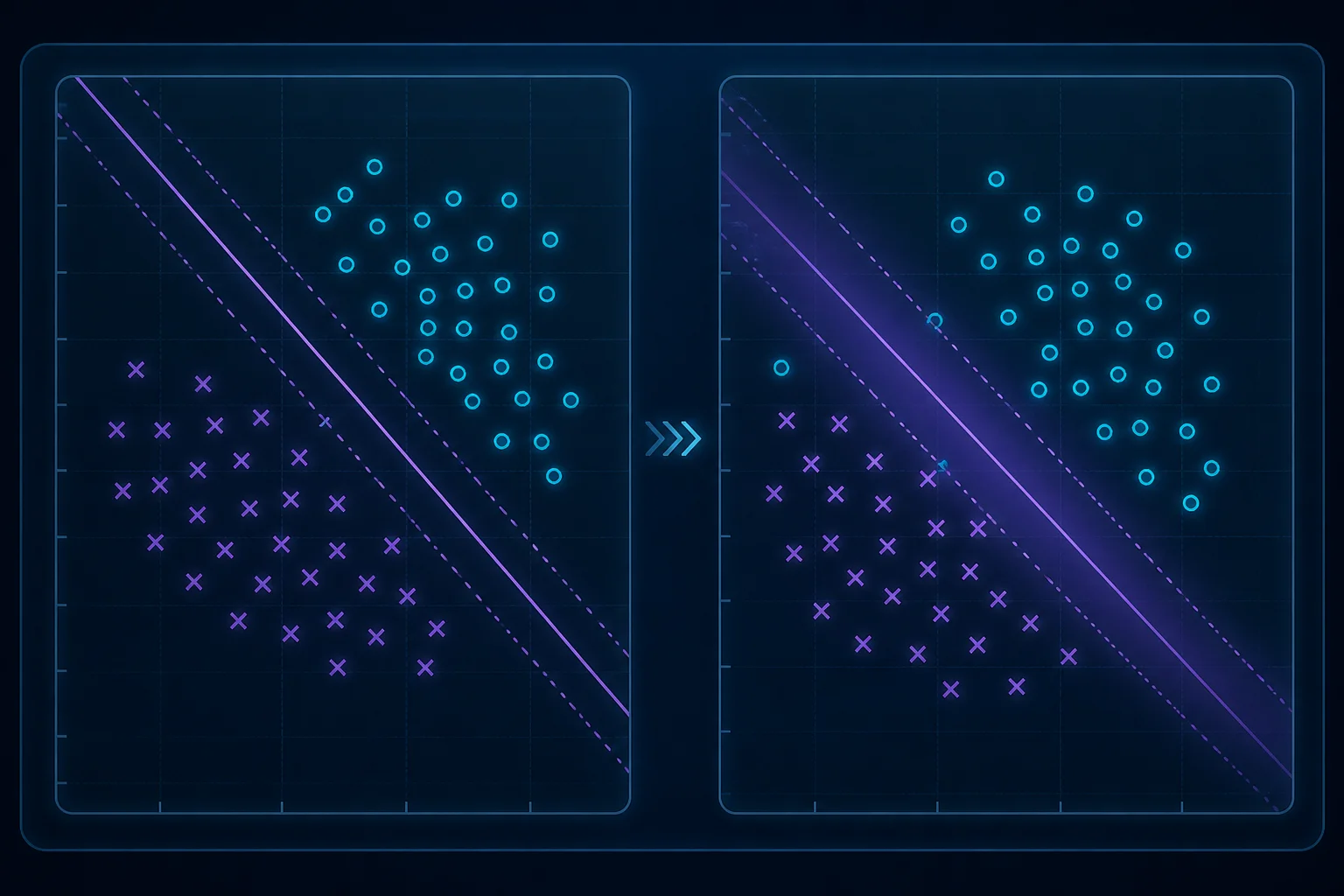
In a logistic model, the outcome is represented through the probability of an event conditional on predictors. Complete separation occurs when a linear combination of predictors perfectly divides observations with and without the event. For example, every participant with a particular exposure pattern may experience the event, while every participant outside that pattern does not. The maximum-likelihood solution attempts to assign probabilities increasingly close to zero and one by sending one or more coefficients toward infinity.
Quasi-complete separation is less absolute but has the same practical consequence: some observations or covariate patterns are separated, while other observations lie on the boundary. A common symptom is a very large standard error, an implausibly large odds ratio, a warning about fitted probabilities, or failure of the iterative algorithm to converge. A clean convergence message does not prove that separation is absent. Analysts should inspect event counts, cross-tabulations for categorical predictors, coefficient magnitudes, standard errors, and sensitivity to model specification.
Separation can occur in a dataset that is not globally small. A large cohort may still contain a sparse subgroup, a rare exposure, a high-dimensional interaction, or a predictor with near-perfect clinical discrimination. Conversely, a small dataset may fit a conventional model if the outcome and covariate patterns are sufficiently balanced. The relevant issue is the information available for the specific parameter, not only the total participant count.
How Firth penalization changes estimation
Firth's method was introduced as a general bias-reduction approach for maximum-likelihood estimates. In logistic regression, the correction modifies the likelihood so that first-order small-sample bias is reduced and finite estimates can be obtained in settings where ordinary maximum likelihood separates. The method is often described as a Jeffreys-prior or penalized-likelihood approach, but the practical point is that it changes the estimation target and the numerical behavior of the model.
The original solution to separation described by Heinze and Schemper showed how Firth-type correction can produce finite estimates when maximum-likelihood estimates do not exist. The result is not an unpenalized coefficient rescued by a technical patch; it is a penalized estimate whose interpretation should be reported as such. A manuscript should state the estimation method, software implementation, penalty or correction used, confidence-interval method, and the exact covariates included.
Firth is different from ridge regression, even though both shrink estimates and can improve numerical stability. Ridge usually shrinks coefficients toward zero through an L2 penalty selected by a tuning process. Firth's correction is motivated by bias reduction and separation handling. The methods can have different coefficient behavior, calibration properties, and inferential interpretations. If the primary objective is prediction, the analysis should compare candidate methods using resampling or external validation rather than choosing one because it converged.
Odds ratios, uncertainty, and clinical interpretation
Firth logistic regression still produces model-based associations. An odds ratio compares the modeled odds of the outcome for two covariate patterns, conditional on the other variables and the model scale. The odds ratio is not automatically a risk ratio, and it may not approximate a risk ratio when the outcome is not rare in the target population. When the event is rare, the distinction may be numerically smaller in some settings, but it remains a reporting issue.
Small samples make uncertainty especially important. Confidence intervals may be wide even when the point estimate is finite. Profile-likelihood intervals, penalized-likelihood intervals, or other methods may be used depending on the implementation. The article should name the method rather than presenting a generic “95% CI” without describing how it was calculated. Analysts should also explain whether the model was intended for etiologic association, prognostic estimation, diagnostic classification, or risk prediction.
A clinically meaningful interpretation should return to the estimand. If the question concerns the adjusted association between an exposure and a binary outcome at a fixed time, report the covariate definition, time horizon, target population, adjustment set, missing-data strategy, and uncertainty. If the question concerns individual risk prediction, report calibration, discrimination, overall prediction error, and validation. The same Firth coefficient can be adequate for one purpose and insufficient for another.
Rare events do not automatically require Firth
Rare outcomes increase the risk of sparse information, but “rare” is not a standalone decision rule. A model with a low event prevalence may be estimable if the sample is large and predictors are modest. A model with a more common outcome may still separate if one predictor or interaction is highly discriminative. The diagnostic question is whether the data support the specified model and estimand.
The 2017 study by Rahman and colleagues evaluated Firth- and logF-type penalized methods in small or sparse binary risk models. Their results illustrate why evaluation should extend beyond convergence. Maximum likelihood showed poor performance in some sparse settings, while penalized methods improved aspects of calibration, discrimination, and overall prediction. The comparison also showed method-specific trade-offs, including differences in bias and convergence. A researcher should therefore define the target and evaluate performance rather than assume that the most stable coefficient automatically creates the best risk model.
The phrase “events per variable” can be useful as a warning about sparse information, but it should not be treated as a universal threshold that determines whether Firth is required. The number of events, predictor complexity, correlations, clinical prior information, missingness, outcome heterogeneity, and validation design all influence the analysis. A prespecified model with fewer clinically necessary variables may be preferable to a large penalized model that is difficult to interpret and validate.
Coefficient estimation is not the same as risk prediction
One of the most important boundaries is the distinction between estimating associations and generating predicted probabilities. A method can reduce coefficient bias while producing probability predictions that require calibration review. Puhr and colleagues reported that Firth's logistic regression reduces bias in maximum-likelihood coefficient estimates, but under strong outcome imbalance its predicted probabilities can be biased toward one-half. They evaluated modifications intended to improve predicted probabilities while examining the trade-off between prediction and effect estimation.

This finding changes how a Firth model should be presented. If the manuscript reports odds ratios for an explanatory analysis, the main concern may be bias reduction and valid uncertainty under separation. If it reports individual predicted risks, the analyst should add calibration plots, calibration slope or intercept where appropriate, discrimination, Brier score or another overall score, optimism correction, and external or temporal validation when feasible.
Calibration is not a decorative figure. A model can rank patients reasonably well while systematically overestimating or underestimating absolute risk. Conversely, a model may show acceptable average calibration while performing poorly in clinically important subgroups. Sparse-data methods can stabilize estimation, but the clinical utility of a prediction model still depends on the outcome definition, predictor measurement, missingness, transportability, and decision context.
What Firth does not repair
Firth penalization addresses a specific estimation problem. It does not remove confounding from an observational study, fix selection bias, correct a misclassified exposure, repair outcome ascertainment, or make a post-treatment covariate safe to adjust for. It also does not justify including a predictor because it appears strongly associated after looking at the outcome. The covariate set should follow the scientific question, temporal ordering, and analysis plan.
The correction does not create information that the study did not collect. If there are very few events, a finite coefficient can still be highly uncertain. If a predictor is measured only in a selected subgroup, the model may not apply to the full cohort. If missing data are informative, fitting Firth to a complete-case subset may preserve a convergence property while changing the target population and introducing bias.
Nor should Firth be used to conceal a failed study design. The 2019 study by Šinkovec and colleagues examined whether increasing the sample size until separation disappeared was more efficient than applying Firth correction to the original data. Their results support treating separation as an estimation problem that can be addressed with a correction, but the broader message is that sampling, model complexity, and study design should be considered explicitly. More data may be the correct solution when feasible; penalization is not permission to stop thinking about recruitment or measurement.
Firth, ridge, logF, and ordinary maximum likelihood
| Approach | Typical role | Important strength | Boundary to report |
|---|---|---|---|
| Maximum-likelihood logistic regression | Standard binary-outcome association or prediction model. | Familiar interpretation and established inference when data are sufficiently informative. | Can yield infinite estimates, convergence failure, or severe small-sample bias under separation and sparse data. |
| Firth-penalized logistic regression | Bias-reduced estimation when events or covariate patterns are sparse and separation is a concern. | Can provide finite estimates when maximum likelihood does not exist. | Changes the estimation procedure; does not guarantee calibrated predictions or causal validity. |
| Ridge logistic regression | Shrinkage for prediction with correlated or numerous predictors. | Can reduce variance and stabilize a high-dimensional model when tuned appropriately. | Penalty selection and clinical interpretability require explicit validation; it is not the same as Firth correction. |
| LogF-type penalization | Alternative penalization for small or sparse binary risk models. | May offer different calibration and coefficient-bias trade-offs in sparse settings. | Requires method-specific implementation and comparison; no method dominates every target. |
Evidence Summary Table
| Evidence or methods source | What it supports | Level and boundary |
|---|---|---|
| Firth, 1993 Foundational article | Bias-reducing penalized likelihood as a general approach to reducing first-order bias in maximum-likelihood estimates. | Foundational statistical method; it does not specify every clinical implementation or prediction-validation workflow. |
| Heinze and Schemper, 2002 PubMed record | Firth correction as a solution to non-existent or infinite maximum-likelihood estimates under separation in logistic regression. | Methodological paper; finite estimates do not remove confounding or poor model specification. |
| Puhr et al., 2017 PubMed record | Firth reduces coefficient bias, while predicted probabilities can show bias toward one-half under strong outcome imbalance; modified methods may improve prediction. | Simulation and applied comparison; prediction and effect-estimation targets should be separated. |
| Rahman et al., 2017 PubMed record | Penalized methods can improve aspects of calibration, discrimination, and overall performance in small or sparse binary risk models, with method-specific trade-offs. | Simulation and real-data illustration; no universal winner across all datasets. |
| Šinkovec et al., 2019 PubMed record | Increasing sample size until separation disappears is not necessarily more efficient than applying Firth correction to the original sparse data. | Simulation-based design comparison; separation does not eliminate the need for recruitment and measurement planning. |
| Suhas et al., 2023 Open-access medical application | Application of Firth penalized logistic regression in a national mental-health survey with sparse-data considerations. | Applied example; one study does not establish superiority across clinical contexts. |
Actionable Steps: Build a defensible Firth analysis
| Step | Research action | Quality gate |
|---|---|---|
| 1. Define the target | State whether the analysis estimates an adjusted association, an odds ratio at a fixed horizon, or individual predicted risk. | The estimand and target population are clinically interpretable before model fitting. |
| 2. Diagnose sparsity | Count events and non-events, inspect categorical cross-tabs, review rare predictor patterns, and check for complete or quasi-complete separation. | The reason for using Firth is documented rather than inferred from a generic convergence warning. |
| 3. Prespecify the model | Define the covariate set, missing-data strategy, coding, interactions, penalty implementation, confidence-interval method, and comparison models. | Firth is not being used to select variables after examining the outcome. |
| 4. Validate the target | For effect estimation, report estimates and uncertainty; for prediction, add calibration, discrimination, overall error, optimism correction, and external or temporal validation where feasible. | The validation plan matches the scientific purpose of the model. |
| 5. Stress-test interpretation | Compare plausible specifications, alternative penalization where relevant, predictor coding, missing-data assumptions, and clinically meaningful subgroups. | Conclusions describe uncertainty and do not treat finite coefficients as proof of causal or clinical importance. |
Common reporting failures
The first failure is saying that Firth was used because the sample was “small” without showing what was sparse. Report event counts, non-event counts, influential predictor patterns, separation diagnostics, or convergence behavior that motivated the method. The second is presenting a very large or very small odds ratio without explaining the penalized estimation procedure and interval calculation.
The third failure is confusing a stable coefficient with a calibrated prediction. A model can return finite odds ratios while its absolute-risk predictions remain poorly calibrated. The fourth is comparing Firth with ordinary logistic regression only by whether the software converged. Prediction models require performance evaluation, while explanatory models require attention to the estimand, confounding, measurement, and uncertainty.
The fifth failure is treating Firth as a cure for overfitting. Penalization can improve numerical behavior, but a model with too many predictors, too little outcome information, or excessive data-driven searching can still be optimistic. The sixth is hiding the covariate-selection process, missing-data decisions, or subgroup exclusions. Reproducible reporting requires the full analytic path, not only the final coefficient table.
Researcher's Toolkit: Audit a Sparse Binary-Outcome Model
Use Lingcore SCI tools to organize the evidence and reporting workflow around Firth and related penalized models:
- Paper Analyzer: Extract event counts, separation diagnostics, covariate coding, penalty method, confidence intervals, calibration, and validation from published logistic-regression studies.
- Review Builder: Build a citation-linked comparison of maximum likelihood, Firth, ridge, logF, and other approaches for sparse binary outcomes.
- Journal Matcher: Compare journals that publish clinical prediction, biostatistics, epidemiology, mental-health surveys, and sparse-data methods.
These tools support evidence organization and quality control. Researchers remain responsible for the estimand, data provenance, model assumptions, validation, and final interpretation.
Conclusion
Firth-penalized logistic regression is a focused method for a focused problem: binary clinical data in which ordinary maximum likelihood is biased, unstable, non-convergent, or unable to produce finite estimates because of sparse information or separation. Its strength is not that it makes every logistic model better. Its strength is that it changes the estimation procedure in a principled way when the data do not support the standard likelihood solution.
A defensible analysis begins with the research target, diagnoses the source of sparsity, prespecifies the covariates and correction, reports uncertainty, and validates the output according to whether the goal is association or prediction. Firth can support honest estimation, but it cannot replace recruitment planning, causal design, careful measurement, missing-data analysis, calibration, external validation, or researcher judgment.