 LINGCORE SCI
Clone-Censor-Weight Analysis in Target Trial Emulation
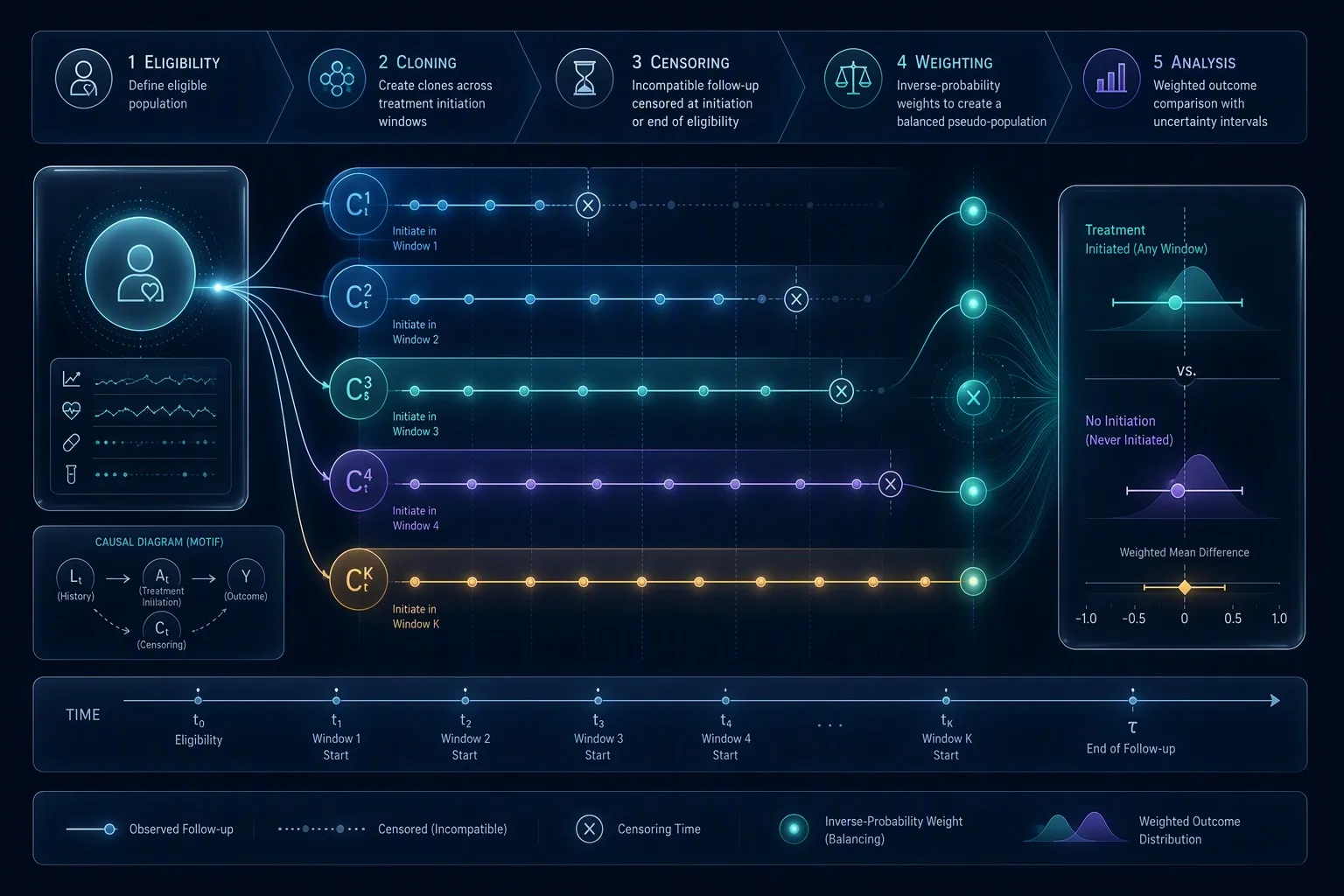
Clone-censor-weight (CCW) analysis emulates a randomized trial when treatment strategies are indistinguishable at baseline, such as starting therapy within different time windows. Eligible individuals are cloned into each regimen, clones are artificially censored when they deviate from their assigned strategy, and inverse probability of censoring weights correct the resulting selection bias before outcome analysis.
Observational treatment studies often compare strategies that cannot be distinguished at the index date. A patient may be eligible to start a therapy immediately, within 30 days, within 90 days, or only after a clinical milestone. At baseline, the same patient can be compatible with several strategies. If the analyst assigns one observed treatment path to one regimen without addressing this ambiguity, the comparison may be poorly aligned with the causal question.
The clone-censor-weight approach provides a principled way to emulate a target trial for these settings. It is especially useful for treatment initiation windows, dynamic treatment strategies, treatment duration, and regimens defined by future treatment behavior. The method does not make observational data equivalent to randomized data. Its purpose is to make the hypothetical intervention explicit and to align eligibility, treatment assignment, follow-up, censoring, and analysis.
1. Begin with a target trial protocol
CCW is not a substitute for specifying the trial that would have been conducted. Define the eligibility criteria, time zero, treatment strategies, assignment period, follow-up, outcome, causal contrast, and analysis plan before inspecting the final results. For an initiation-window question, state exactly what “start within 30 days” means and what happens to people who have not initiated by the end of the window.
The hypothetical intervention may not be as simple as its label. “Start by day 30” can allow natural initiation on any day from zero through day 30 and then assign treatment at day 30 to those who remain untreated. “Start between day 30 and day 90” may prevent early initiation, allow initiation during the window, and assign treatment at day 90 to those who have not initiated. These strategies have different exposure histories and should not be treated as interchangeable.
Specify the estimand in terms of the intervention rather than relying on a short regimen name. State whether the contrast is a risk difference, risk ratio, survival probability difference, restricted mean survival time, or another measure at a defined horizon. If the intervention changes treatment timing, explain whether the estimand reflects the entire treatment history induced by that timing rule.
2. Identify the eligible population and index date
Construct the cohort around a clinically meaningful time zero. Eligibility can be assessed at hospital discharge, diagnosis, treatment indication, procedure date, or another decision point at which the treatment strategies could plausibly be assigned. Apply the same eligibility logic to all clones and avoid using information that would only become available after the index date.
Potential index dates require particular care. A person may meet the eligibility criteria more than once, and repeated eligibility can create dependence or duplicate opportunities. Prespecify whether the study uses the first eligible date, a random eligible date, all eligible dates with appropriate clustering, or a washout period that separates episodes.
Define baseline covariates using a window that ends at time zero. Include variables that could affect treatment initiation, censoring, and outcome risk. A variable measured after the index date may be a mediator or a consequence of early treatment and should not be inserted into baseline adjustment without a clear causal rationale.
3. Clone each eligible individual into the regimens
Each eligible person is copied into one clone for each treatment strategy that they satisfy at baseline. If the study compares three initiation windows, each person begins with three clones. The clones share the person’s baseline characteristics and outcome history at time zero, but each is assigned to a different hypothetical regimen.
Cloning is not duplicating evidence to increase the sample size. It creates regimen-specific records so that the same individual can contribute information to several initially compatible strategies. The analysis must account for the dependence among clones, usually through robust variance estimation or another method that recognizes the repeated contribution of the original individual.
Baseline compatibility rules should be explicit. If prior treatment makes a person incompatible with a no-treatment strategy, that clone should not be included in that regimen. If treatment histories are already inconsistent with a planned duration or initiation window, the corresponding clone should be excluded or handled according to the prespecified protocol.
4. Define artificial censoring from regimen deviation
After cloning, each clone is followed under its assigned regimen until it deviates. A clone assigned to “initiate by day 30” may be censored if the person remains untreated beyond day 30. A clone assigned to “initiate between days 30 and 90” may be censored if treatment starts before day 30 or fails to start by day 90. The censoring rule must be defined from the hypothetical intervention.
Artificial censoring is not the same as ordinary loss to follow-up. It is created by the analysis because observed treatment behavior no longer agrees with the assigned strategy. If deviation is associated with prognosis, simply dropping the clone can introduce selection bias. The weighting step is designed to account for this informative artificial censoring.
Record the timing and reason for each censoring event. Multiple mechanisms may exist, including early initiation, late initiation, treatment discontinuation, rescue therapy, or failure to remain within a strategy. Collapsing all deviations into one undocumented indicator makes it difficult to assess whether the weights correspond to the causal question.
5. Estimate inverse probability of censoring weights
At each person-period, estimate the probability that a clone remains uncensored under its assigned regimen, conditional on measured covariates and treatment history. The inverse of this probability increases the contribution of clones that remain compatible despite having characteristics associated with deviation. The weighted cohort approximates the population that would have continued to follow each strategy.
Weight models should reflect the time-varying nature of the problem. Use baseline and time-updated variables that are available before each censoring decision and that plausibly predict both deviation and the outcome. Fit separate models when censoring mechanisms differ, such as early treatment versus delayed treatment, unless a unified model is clearly justified.
Stabilized weights can improve precision, but stabilization does not eliminate positivity problems. Inspect the distribution of weights, truncation decisions, effective sample size, and covariate balance across time. Extreme weights may signal sparse data, a strategy that is rarely followed, poor model specification, or a treatment window that is not feasible in the observed setting.
6. Analyze the weighted clone cohort
Once clones have been censored and weighted, estimate outcomes under each regimen over the prespecified follow-up period. Depending on the outcome and estimand, researchers may use weighted Kaplan–Meier methods, pooled logistic regression, weighted survival models, or other marginal structural approaches. The model should estimate the contrast defined in the target trial protocol.
Variance estimation must reflect both the weighting and the fact that multiple clones originate from the same individual. Use robust or cluster-appropriate standard errors with the original participant as the clustering unit. Standard errors that treat clones as independent can be too small and make the result appear more precise than it is.
Present the outcome curve or risk under each regimen, the treatment contrast with uncertainty, the number of original participants and clones, the amount and timing of artificial censoring, and the effective sample size after weighting. A single adjusted hazard ratio without this context is not an adequate CCW report.
7. Understand what the initiation-window effect means
CCW estimates can be difficult to interpret when comparing treatment initiation windows. “Start by day 30” and “start by day 90” may induce different exposure patterns for different populations because the natural timing of initiation varies. The difference between regimens may be small in one cohort and large in another even when the labels are identical.
Describe the observed initiation distribution and the exposure history implied by each hypothetical intervention. A regimen that assigns treatment at the end of a window creates a treatment pattern that may differ from simply observing people who happened to start early. The causal contrast is determined by the intervention, not only by the name of the treatment group.
This distinction matters for clinical translation. A result comparing initiation windows should tell clinicians what policy or care pathway it represents. If a hospital cannot deliver forced initiation at the end of a grace period, the estimated effect may not map directly to its operational decision.
8. Evidence summary table
| Methodology or guidance | Contribution | Practical implication |
|---|---|---|
| Webster-Clark et al., Pharmacoepidemiology and Drug Safety 2025 | Provides a detailed CCW tutorial using treatment initiation windows and synthetic Medicare claims data. | Follow the five-part structure: identify, clone, censor, weight, and analyze, while describing the causal contrast. |
| Hernán and Robins target-trial framework | Defines the protocol components needed to turn an observational question into a target-trial emulation. | Specify eligibility, treatment assignment, time zero, follow-up, outcomes, causal contrast, and analysis before estimation. |
| Clone-censor-weight methodology | Aligns initially indistinguishable treatment strategies and addresses immortal-time and selection problems through artificial censoring and IPCW. | Do not discard regimen-deviating clones without modeling informative censoring. |
| TARGET reporting guideline | Provides reporting recommendations for observational studies explicitly emulating a parallel-group randomized trial. | Report the target trial protocol, data source, treatment strategies, deviations, weights, estimand, and limitations transparently. |
| Inverse probability weighting principles | Connects censoring weights to exchangeability, positivity, and correct model specification. | Inspect weight diagnostics, effective sample size, truncation, and residual selection bias. |
9. A practical CCW workflow
| Step | Research action | Required output |
|---|---|---|
| Step 1 | Write the target trial protocol, define time zero, eligibility, treatment windows, outcome, follow-up, and estimand. | Versioned protocol and causal diagram |
| Step 2 | Identify eligible records and create one clone for every regimen compatible at baseline. | Clone-level cohort with regimen assignment |
| Step 3 | Censor clones when observed behavior deviates from the assigned hypothetical strategy. | Time-stamped censoring indicators and reasons |
| Step 4 | Estimate time-varying inverse probability of censoring weights and evaluate positivity, balance, and effective sample size. | Weight diagnostics and stabilized analysis dataset |
| Step 5 | Estimate regimen-specific outcomes with clone-clustered variance and conduct sensitivity analyses. | Causal contrast, uncertainty interval, and robustness report |
10. Common implementation errors
A frequent error is defining treatment groups using future exposure without cloning. This can create immortal time because patients must survive or remain outcome-free long enough to be classified into a later-initiation group. CCW avoids this classification problem by assigning compatible clones at baseline and then censoring deviations as they occur.
Another error is censoring without weighting. The remaining clones are not a random sample of those who would have followed the regimen. If deviation depends on evolving health status, the complete cases can differ systematically from the full eligible population. IPCW addresses this under conditional exchangeability and positivity assumptions, but it does not repair unmeasured predictors of deviation.
Researchers also sometimes treat clones as independent people, use a single unexplained weight model, or report only the final effect estimate. These choices hide the structure that makes CCW valid. A transparent report should show how many clones were created, when they were censored, why they were censored, how weights were estimated, and how variance was calculated.
11. Sensitivity analysis and limitations
Test how results change under alternative treatment windows, eligibility definitions, grace-period rules, outcome definitions, weight truncation thresholds, and censoring models. If the treatment effect varies over time, consider whether the comparison of initiation windows represents a clear clinical intervention or a mixture of exposure histories.
Assess unmeasured predictors of artificial censoring and outcome risk. A negative control outcome or negative control exposure may help detect residual bias in some settings, but such analyses require a plausible control and do not prove the primary estimate is unbiased. Quantitative bias analysis can describe how strong an unmeasured factor would need to be to change the conclusion.
CCW can be computationally demanding and difficult to explain to clinical readers. The method should be used because it matches the causal question, not because it is more sophisticated than a conventional analysis. If the treatment strategies are already distinguishable at baseline and the time-zero definition is clear, a simpler target-trial emulation may be more transparent.
Strengthen your target-trial evidence workflow with Lingcore SCI tools
CCW analysis requires careful review of the hypothetical intervention, eligibility logic, treatment timing, censoring process, weight model, and estimand. Lingcore SCI provides specialized tools for medical researchers:
- Paper Analyzer: Audit target-trial emulations for immortal-time bias, clone assignment, artificial censoring, IPCW, and variance estimation.
- Review Builder: Synthesize CCW and causal-inference evidence with verified citations, clear estimands, and structured assumptions.
- Journal Matcher: Identify pharmacoepidemiology, causal-inference, clinical epidemiology, and real-world evidence journals suited to CCW studies.
Conclusion
Clone-censor-weight analysis makes target-trial emulation feasible when treatment regimens are initially indistinguishable, especially for treatment initiation windows and dynamic strategies. The method works by cloning eligible individuals into compatible regimens, censoring clones after deviation, weighting the remaining clones to address informative censoring, and analyzing outcomes with dependence-aware variance estimates. Its credibility depends on a well-defined target trial, correct time zero, valid censoring models, adequate positivity, and transparent reporting of the causal contrast. Used with these safeguards, CCW can turn complex treatment-timing questions into explicit, auditable causal analyses.