 LINGCORE SCI
Bayesian Hierarchical Models for Treatment-Effect Heterogeneity in Multicenter Clinical Research
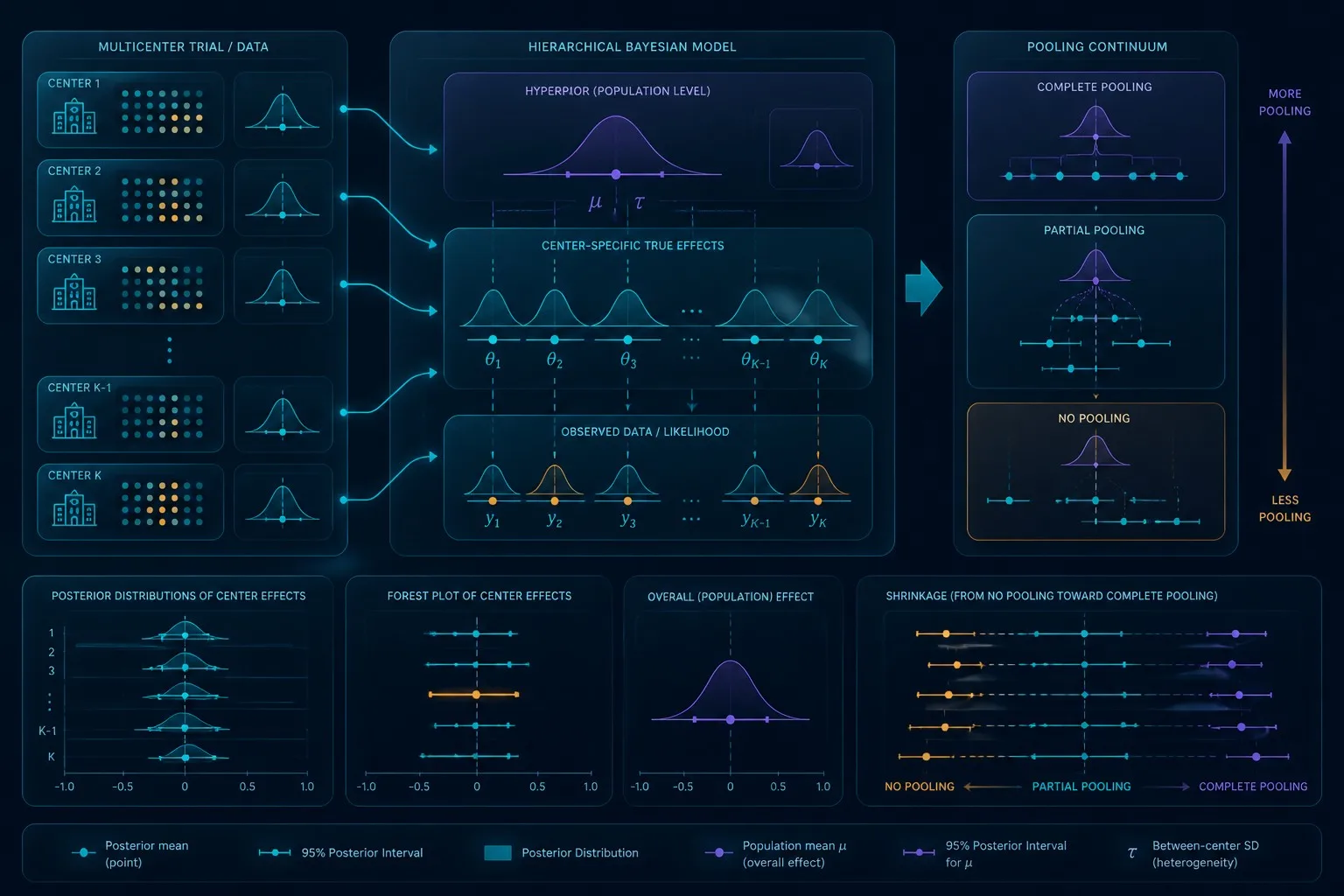
Bayesian hierarchical models estimate center- or subgroup-specific treatment effects while allowing controlled information sharing through partial pooling. They are useful when multicenter estimates are heterogeneous but individually imprecise. A defensible analysis must prespecify the hierarchy, justify exchangeability and priors, evaluate complete pooling versus no pooling, inspect posterior heterogeneity, and report how borrowing changes the treatment-effect estimates.
Multicenter clinical research produces evidence at several levels. Patients are treated within hospitals, regions, practices, or trial centers, and the treatment effect may vary across those settings. Some centers may have enough participants to estimate a local effect with reasonable precision; others may contribute few events and produce wide intervals. A single pooled estimate can ignore meaningful heterogeneity, while completely separate estimates can be too unstable to support decisions.
Bayesian hierarchical modeling offers a middle path. Center-specific or subgroup-specific effects are modeled as related but not identical quantities. The model estimates a distribution of effects and allows information to be shared according to the observed data and the assumed hierarchical structure. This is often called partial pooling. It is not a license to make small centers look like the overall average; the amount of shrinkage is an inferential consequence that must be examined and justified.
1. Define the heterogeneity question
Start by distinguishing the scientific questions that are often mixed together. A multicenter trial may ask for an overall treatment effect, the distribution of effects across centers, prediction of the effect in a new center, or identification of effect modification by a baseline subgroup. Each question requires different summaries and different assumptions.
Center heterogeneity may reflect differences in patient mix, treatment delivery, outcome ascertainment, background care, protocol adherence, or random variation. A center-specific random effect is not automatically a biologic treatment-effect modifier. Decide whether the hierarchy represents sites, regions, demographic subgroups, disease subtypes, or another meaningful level of variation.
Prespecify which variables define the subgroup structure and whether interactions are treatment-by-subgroup effects or center-level deviations. The analysis should state whether the goal is descriptive exploration, confirmatory subgroup inference, prediction for future settings, or a regulatory decision. A posterior probability statement has meaning only relative to that target.
2. Choose complete, no, or partial pooling
Complete pooling assumes one common treatment effect across all centers or subgroups. It is statistically efficient when the assumption is reasonable, but it can conceal heterogeneity and produce overconfident decisions for a setting whose effect differs from the average.
No pooling estimates each center independently. It avoids borrowing information across centers, but estimates can be unstable when sample sizes are small. Wide posterior intervals may be scientifically honest, yet they can make prediction and decision-making difficult when many centers have sparse data.
Partial pooling places center-specific effects in a common distribution. Centers with little information are pulled more strongly toward the overall mean, while centers with more information retain more of their local signal. The amount of shrinkage depends on within-center uncertainty and the between-center variance. Partial pooling should not be described as simply “more accurate” without clarifying the assumed exchangeability and the inferential target.
3. Specify the hierarchy and likelihood
For a binary endpoint, one model may use a binomial likelihood with a logit link and center-specific treatment effects. For continuous outcomes, a normal likelihood or a robust alternative may be appropriate. For time-to-event outcomes, the hierarchy can be placed on a log hazard ratio, a log rate ratio, a restricted mean survival contrast, or another estimand that matches the clinical question.
Model specification should reflect the treatment assignment and the trial design. In a randomized trial, baseline treatment assignment is protected within the trial, but center-level treatment effect estimation can still be affected by outcome model choice, sparse events, differential follow-up, and center-by-treatment interactions. In observational multicenter research, additional confounding control is required before a hierarchical treatment-effect model can be interpreted causally.
Do not select a link function because it is familiar. The estimand scale affects interpretation and pooling. A normal hierarchy on a risk difference is not equivalent to a normal hierarchy on a log odds ratio. If effects are pooled on a relative scale but decisions are made on an absolute-risk scale, report how baseline risk is incorporated into the clinical interpretation.
4. Treat priors as design choices
The prior for the overall treatment effect and the prior for between-center heterogeneity influence posterior estimates, especially when the number of centers or events is small. Priors should be scientifically defensible, transparent, and assessed through sensitivity analysis. A weakly informative prior is not automatically neutral, and a highly concentrated prior can force strong borrowing that the data do not support.
For the between-center standard deviation, consider whether the plausible range of treatment-effect variation is expressed on the chosen scale. A prior that appears broad on an odds-ratio scale may be extremely broad on a risk-difference scale, or vice versa. Simulation can show how the prior translates into plausible center-specific effects and posterior shrinkage.
Prior predictive checks are useful before fitting the final model. Generate outcomes or treatment-effect patterns from the proposed priors and ask whether they are clinically plausible. If the model routinely predicts implausibly large benefits or harms, revise the prior or explain why those possibilities are scientifically acceptable.
5. Understand shrinkage and posterior borrowing
Partial pooling changes the center-specific estimate by combining local data with the hierarchical distribution. The posterior center effect is influenced by the local likelihood, the overall mean, and the estimated between-center variance. When heterogeneity is estimated to be small, shrinkage is stronger; when heterogeneity is larger, centers are allowed to remain more distinct.
Borrowing is not a binary decision. It is a continuous consequence of the model. Report the degree of shrinkage, the posterior between-center variance, and how center-specific estimates compare with unpooled estimates. A forest plot can display both raw or unpooled estimates and posterior hierarchical estimates, with clear labels.
When center effects are exchangeable, borrowing may improve estimation for small centers. If centers are systematically different in ways not represented by the hierarchy, exchangeability can be questionable. Consider covariate-informed hierarchies, region-level predictors, or a model that separates explainable effect modification from residual center heterogeneity.
6. Distinguish heterogeneity from interaction
Heterogeneity describes variation in treatment effects across units. Effect modification asks whether that variation is explained by a baseline characteristic or clinical context. A random center effect may indicate unexplained variation but does not identify why it occurs.
For a subgroup variable, include a treatment-by-subgroup interaction when the scientific question concerns differential response. The interaction should be interpreted on the scale used in the model and translated into clinically meaningful contrasts. A large difference in odds ratios may correspond to a small difference in absolute benefit when baseline risks differ.
Do not use separate within-subgroup significance tests as the primary test of heterogeneity. One subgroup can have a significant result and another a non-significant result even when the effects do not differ meaningfully. Model the contrast directly and report its posterior distribution or credible interval.
7. Report posterior probability responsibly
Bayesian analyses often report quantities such as the posterior probability that a treatment effect exceeds zero or that a subgroup benefit exceeds a clinically relevant margin. These probabilities are conditional on the model, prior, data, and assumptions. They are not universal probabilities that the treatment works in every future patient.
Define the threshold before analysis. A posterior probability above a chosen cutoff should be linked to a decision rule, such as further study, implementation, or a safety review. The cutoff and operating characteristics should be justified, particularly when the analysis is intended to support a confirmatory or regulatory decision.
Report posterior means or medians, credible intervals, probabilities for clinically relevant thresholds, and sensitivity to priors and model structure. Avoid presenting a single posterior probability without showing the underlying effect scale and uncertainty.
8. Evidence summary table
| Methodology or guidance | Contribution | Practical implication |
|---|---|---|
| Shergina et al., J Biopharm Stat | Demonstrates Bayesian hierarchical modeling for controlled post hoc subgroup analysis and information sharing. | Develop the analysis plan before subgroup unblinding when possible and evaluate operating characteristics through simulation. |
| BMC Medical Research Methodology 2024 comparison | Compares Bayesian hierarchical meta-regression approaches and partial-pooling behavior under heterogeneous effects. | Compare pooling assumptions, posterior predictions, heterogeneity estimates, and target decision performance. |
| FDA Bayesian subgroup analysis statistical plan | Provides a regulatory-oriented example of hierarchical Bayesian subgroup analysis, borrowing, and prespecified decision criteria. | Document priors, borrowing, operating characteristics, subgroup definitions, and success thresholds. |
| ICH E9 Statistical Principles | Establishes principles for appropriate design, analysis, interpretation, and evaluation of clinical trials. | Align the hierarchy and subgroup analysis with the estimand, study objectives, and clinically relevant decisions. |
| JAMA Guide to Bayesian Hierarchical Models | Explains complete pooling, no pooling, partial pooling, prior structure, and interpretation of hierarchical estimates. | Show how the selected pooling strategy changes estimates and uncertainty rather than reporting only the final model. |
9. Actionable Steps: A Practical Multicenter Bayesian Workflow
| Step | Research action | Required deliverable |
|---|---|---|
| Step 1 | Define the overall effect, center or subgroup effects, clinical margin, and decision the model will support. | Estimand table and hierarchy diagram |
| Step 2 | Specify the likelihood, link, treatment-effect scale, center hierarchy, covariate interactions, and prior distributions. | Versioned Bayesian analysis plan |
| Step 3 | Run prior predictive checks, simulation-based operating-characteristic evaluations, and sensitivity analyses for pooling. | Prior and simulation diagnostics |
| Step 4 | Fit complete-pooling, no-pooling, and partial-pooling benchmarks where appropriate; assess convergence and posterior predictive fit. | Comparative model-checking report |
| Step 5 | Report overall and center-specific effects, shrinkage, heterogeneity, posterior probabilities, credible intervals, and clinical implications. | Transparent posterior evidence and decision summary |
10. Simulation is part of the evidence
Simulation can evaluate how the proposed hierarchy behaves under plausible center sizes, event rates, effect distributions, missingness, and heterogeneity. Examine bias, interval coverage, false-positive behavior, power or posterior decision probabilities, and the accuracy of predictions for new centers.
Simulations should vary the true between-center variance and the degree of imbalance. A model that performs well when effects are exchangeable may behave differently when one center has a genuinely different effect. Include scenarios with sparse centers, influential centers, non-normal effect distributions, and prior-data conflict.
For regulatory or confirmatory work, simulation should be connected to a prespecified decision rule. If the analysis declares success when a posterior probability exceeds a threshold, evaluate the probability of that declaration under null, clinically meaningful, and adverse scenarios. Report the assumptions and make the simulation code or sufficient details available when possible.
11. Diagnose convergence, fit, and prior-data conflict
Convergence diagnostics are necessary but not sufficient. Inspect effective sample sizes, trace behavior, Monte Carlo error, R-hat or equivalent diagnostics, and sensitivity to initialization. Posterior predictive checks should compare the model’s replicated data with the observed distribution at both the overall and center levels.
Prior-data conflict can appear when the observed center effects are inconsistent with the assumed hierarchy. A narrow prior for heterogeneity may produce excessive shrinkage, while a diffuse prior may leave estimates unstable. Report how the posterior changes under plausible alternative priors and whether the clinical conclusion is robust.
Check influential centers and influential observations. A center with unusual event rates, measurement procedures, or treatment delivery can dominate the estimated heterogeneity. Sensitivity analyses may exclude or model that center, but the rationale must be substantive rather than chosen because the result is inconvenient.
12. Common interpretation errors
Partial pooling is not the same as proving that center effects are equal. It is a modeling compromise that regularizes noisy estimates. A narrow posterior interval after strong borrowing may reflect the prior and hierarchy as well as the observed information.
Another error is treating a posterior probability as a replacement for clinical effect size. A high probability that the effect is positive does not establish that the benefit is clinically important. Report probabilities relative to a prespecified minimal clinically important difference and include absolute effects when possible.
Finally, do not use hierarchical modeling to conceal poor data quality, confounding, missing outcomes, or incompatible center definitions. Borrowing cannot repair a biased estimand. The hierarchy should be added after the data-generating process, measurement, treatment assignment, and target population have been described.
Researcher’s Toolkit: Strengthen Your Multicenter Bayesian Workflow
Hierarchical treatment-effect analysis requires careful review of center structure, subgroup definitions, priors, simulations, model diagnostics, and clinical interpretation. Lingcore SCI provides specialized tools for medical researchers:
- Paper Analyzer: Audit Bayesian hierarchical models for pooling assumptions, priors, convergence, posterior predictive checks, and subgroup interpretation.
- Review Builder: Synthesize evidence on treatment-effect heterogeneity, partial pooling, Bayesian subgroup analysis, and multicenter inference.
- Journal Matcher: Identify biostatistics, clinical-trial, medical-statistics, and regulatory-science journals suited to hierarchical Bayesian research.
Conclusion
Bayesian hierarchical models provide a principled framework for estimating treatment-effect heterogeneity when multicenter or subgroup-specific data are uneven. Partial pooling can stabilize sparse estimates while preserving meaningful variation, but its credibility depends on the hierarchy, exchangeability assumptions, priors, likelihood, and target decision. A rigorous analysis compares pooling strategies, uses simulation and posterior predictive checks, reports shrinkage and uncertainty, and translates posterior probabilities into clinically relevant effects. Used transparently, hierarchical Bayesian modeling can turn scattered center-level evidence into a more informative picture of both the overall treatment effect and the settings in which it may differ.