 LINGCORE SCI
The Impact of AI on Clinical Trial Recruitment: Ethical and Regulatory Perspectives

Table of Contents
- 1. The Recruitment Crisis in Clinical Research
- 2. How AI is Transforming Patient Identification
- 3. Navigating the Ethical Landscape: Bias and Representation
- 4. Data Privacy and Informed Consent in the AI Era
- 5. Regulatory Requirements: FDA and EMA Guidelines
- 6. Reporting AI-Driven Recruitment in SCI Manuscripts
- 7. Researcher's Toolkit: Lingcore SCI Solutions
- 8. Conclusion: The Future of Luminous Evidence
In the rapidly advancing landscape of medical research in 2026, clinical trial recruitment remains one of the most significant bottlenecks in drug development and evidence-based medicine. Traditional recruitment methods are often slow, expensive, and result in highly homogeneous patient populations that fail to reflect the diversity of the real world. Artificial Intelligence (AI) has emerged as a disruptive force, promising to streamline patient identification, enhance recruitment precision, and accelerate the transition from protocol to publication. However, this technological leap brings a host of ethical and regulatory challenges that researchers must navigate with academic rigor. This guide explores the impact of AI on clinical trial recruitment, focusing on maintaining ethical integrity and achieving regulatory compliance for high-impact SCI publication.
Core Insight: AI is not merely a search tool; it is a complex algorithmic framework capable of analyzing Electronic Health Records (EHRs), social media behavior, and genetic data to find eligible participants. In 2026, the success of a trial depends as much on the transparency of its AI recruitment strategy as it does on its clinical primary endpoints.
How AI is Transforming Patient Identification
AI's primary strength lies in its ability to process vast, unstructured datasets. By leveraging Natural Language Processing (NLP) and Machine Learning (ML), AI engines can "read" through millions of physician notes and lab results to identify patients who meet complex inclusion and exclusion criteria. This automated screening reduces the burden on clinical site staff and identifies "hidden" candidates who might have been overlooked by manual review.
Furthermore, AI can predict patient adherence and drop-out rates by analyzing historical behavioral data. This allows researchers to recruit a more "resilient" cohort, ultimately protecting the statistical power of the study. In 2026, AI-driven recruitment is no longer a luxury of big pharma; it is an essential component of decentralized clinical trials and real-world evidence synthesis.
Navigating the Ethical Landscape: Bias and Representation
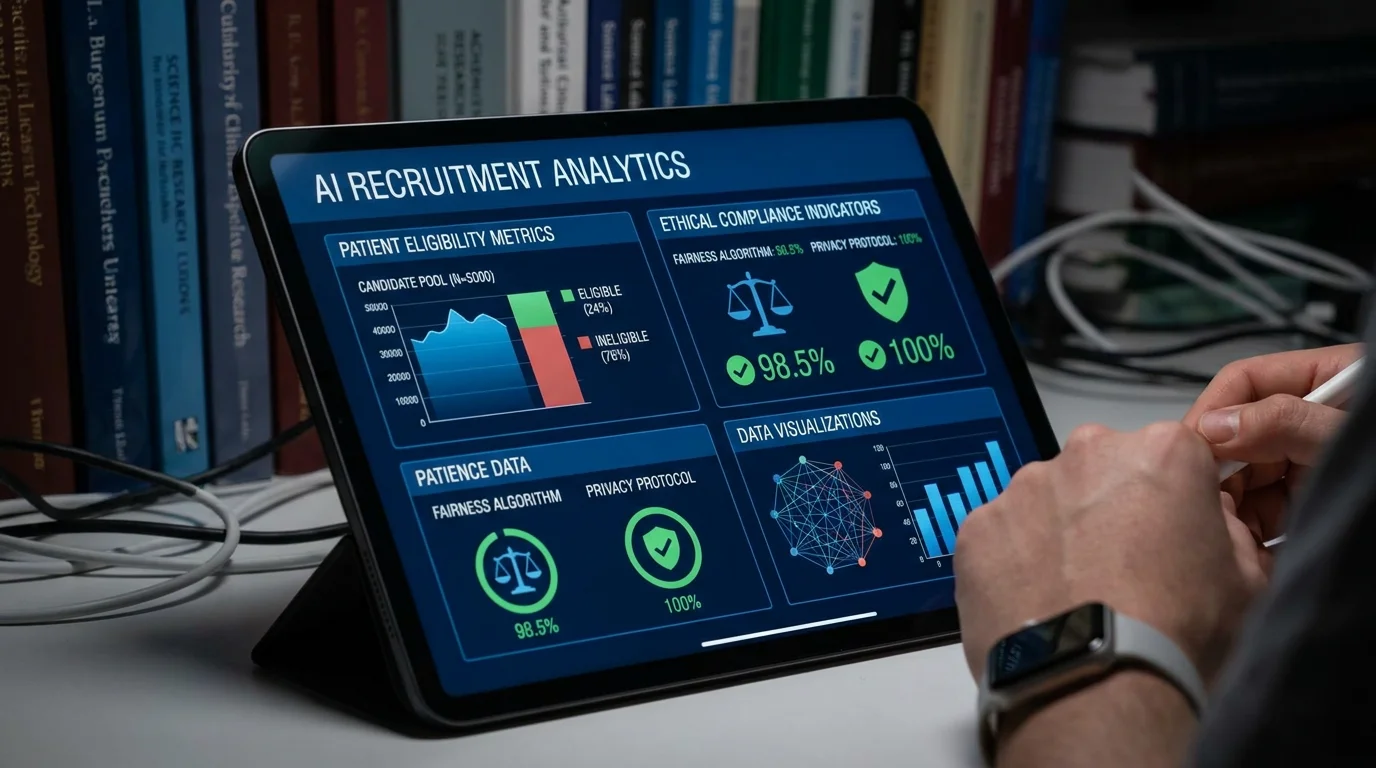
While AI offers efficiency, it also risks magnifying existing biases in medical data. If the underlying datasets used to train recruitment algorithms are skewed toward certain ethnic or socioeconomic groups, the AI will naturally prioritize those groups in recruitment. This creates a cycle of algorithmic bias that undermines the principle of justice in research.
Mitigating Algorithmic Bias
- Diverse Training Sets: Ensure that recruitment algorithms are trained on representative global datasets.
- Audit and Transparency: Proactively audit AI performance for disparate impact across different demographic subgroups.
- Human Oversight: AI should serve as a screening assistant, with final eligibility determined by a qualified clinical investigator.
Data Privacy and Informed Consent in the AI Era
AI recruitment often involves the analysis of highly sensitive personal health information. In the era of the EU's GDPR and the US HIPAA, protecting patient privacy is a non-negotiable requirement. Researchers must be transparent about how AI is used to identify participants. Does the patient know their EHR was scanned by an algorithm? How is the data de-identified during the screening phase?
Informed consent documents in 2026 must explicitly address the use of AI in recruitment and data analysis. Participants have a right to know if their "digital twin" or historical health data is being used to predict their eligibility or outcomes. Failure to address these privacy concerns can lead to immediate rejection by Institutional Review Boards (IRBs) and journal editors alike.
Regulatory Requirements: FDA and EMA Guidelines
Regulatory bodies have recognized the importance of AI in research and have issued specific guidance. The FDA's "AI/ML-Based Software as a Medical Device" framework and the EMA's "Artificial Intelligence in Research" white papers provide the standards for 2026. These guidelines emphasize Traceability, Robustness, and Transparency (TRT).
When submitting a protocol or a manuscript that utilized AI-driven recruitment, researchers must provide a "Technical Appendix" describing the algorithm, the data sources used for training, and the measures taken to ensure data security. Adhering to these regulatory standards is a prerequisite for passing the technical screening of top-tier SCI journals.

Reporting AI-Driven Recruitment in SCI Manuscripts
In 2026, the CONSORT-AI and SPIRIT-AI reporting standards have been updated to include recruitment-specific items. When writing your manuscript, you must be explicit about the role of AI. Vague statements like "AI was used for screening" are insufficient. You must report:
- The specific AI model or software version used.
- The data sources integrated into the AI screening process.
- The number of participants identified by AI vs. those identified by traditional methods.
- A formal assessment of recruitment diversity and algorithmic fairness.
Researcher's Toolkit: Lingcore SCI Solutions
Integrating AI into clinical trial design requires a delicate balance of technological expertise and ethical foresight. At Lingcore SCI, we have developed specialized tools to help researchers achieve this balance with academic precision.
Elevate Your Clinical Trial Design with Lingcore SCI
Ready to lead the future of data-driven recruitment? Access our specialized AI-driven tools designed for medical research excellence:
- Paper Analyzer: Audit the recruitment and ethical sections of your protocol. Our AI identifies potential gaps in your compliance with SPIRIT-AI and CONSORT-AI standards.
- Review Builder: Analyze recruitment trends in your field. Our engine identifies which AI-driven recruitment strategies have been most successful in similar high-impact clinical trials.
- Journal Matcher: Find journals that specialize in digital health and AI-integrated research. We match your trial's innovation with the right editorial audience.
Conclusion: The Future of Luminous Evidence
The integration of AI into clinical trial recruitment represents a paradigm shift in how we generate medical evidence. By moving from manual identification to data-driven precision, we can accelerate the pace of scientific discovery and bring life-saving treatments to patients faster. However, the true value of AI lies not just in its speed, but in its ability to make research more inclusive and transparent. By navigating the ethical and regulatory landscape with integrity, you ensure that your research is not just technologically advanced, but also ethically sound and academically authoritative. At Lingcore SCI, we remain your dedicated partner in this journey toward a more luminous and data-driven future of medicine.
As you plan your next clinical trial, remember that AI is a tool that requires human wisdom. Be transparent about your methods, rigorous in your audits, and uncompromising in your commitment to patient privacy. Together, let's redefine the standards of clinical excellence.